Skip to Content

Historical Crests Genoa CFC

Name: Genoa CFC
Nickname(s): ​Il Grifone (The Griffin)
Founded: 1893
Stadium: ​Stadio Luigi Ferraris (Genoa)
Capacity: ​​36,599

1893-1980
1980-1980s
1980s
1980s-1991
1991-1998
1998-2022
2022-Present

Genoa CFC Crest History
The earliest emblems used by the club during the late nineteenth and early twentieth centuries were essentially adaptations of the coat of arms of the city of Genoa
During the Fascist period between 1928 and 1945, the club was forced to abandon its English name and compete as Genova 1893. The crest was modified accordingly, incorporating civic symbols while reducing references to the club's international origins. Although the Griffin remained present, the traditional identity was partially altered as part of the wider campaign against foreign influences.
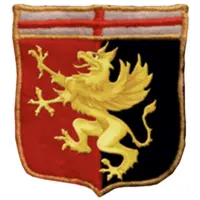
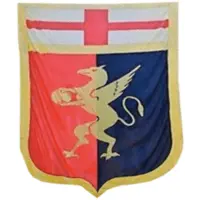
Following the Second World War, Genoa returned to its historic name and restored many of its traditional symbols. The crest evolved into a shield featuring the Cross of Saint George in the upper section and the club's red-and-blue colours below. A single golden griffin replaced the pair that appeared in the city's coat of arms and became the central symbol of the club. This basic structure would remain the foundation of Genoa's identity for decades.
The badge used from the 1960s through the 1970s established what many supporters regard as the classic Genoa crest. The shield featured the Cross of Saint George at the top, while the lower section displayed the traditional red-and-blue background with a golden griffin standing proudly in the centre. This design accompanied Genoa through much of the post-war era and reinforced the club's connection to the city.
A dramatic departure from tradition arrived in the 1980s. The club experimented with a highly stylised Griffin logo that abandoned the traditional heraldic shield. The creature was depicted with a red head and blue body in a minimalist graphic style. Many supporters nicknamed this version "Il Gallinaccio" ("The Big Chicken"), and it remains one of the most controversial badges in the club's history. While distinctive, it lacked the historic symbolism that many fans associated with Genoa.
During the late 1980s and early 1990s, the club gradually returned to a more traditional identity. The shield shape was restored, and the Griffin once again became the dominant feature. This redesign coincided with one of Genoa's strongest modern periods, including its memorable UEFA Cup campaigns and return to prominence in Italian football.
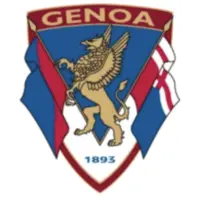
A major redesign arrived in the early 1990s. The club introduced a more elaborate crest featuring a powerful golden griffin standing above the traditional red-and-blue colours. The Griffin was depicted in a more dynamic heraldic style, with raised wings and a proud stance. This version became one of the most recognisable badges in the club's history.
In 1998, the badge was refined further. The overall structure remained similar, but the design became cleaner and more balanced. The Griffin was modernised, typography improved and proportions adjusted. This crest accompanied Genoa through much of the early twenty-first century and became familiar to an entire generation of supporters.
A further update arrived in 2022. Rather than introducing a completely new identity, Genoa simplified the existing crest by removing unnecessary details and refining the Griffin's appearance. The creature was given cleaner lines and a more modern profile, while the traditional shield featuring the Cross of Saint George and the Rossoblù colours remained unchanged. 

Genoa CFC Club History
Founded in 1893 as Genoa Cricket and Athletic Club by British businessmen and expatriates living in the port city of Genoa, Genoa CFC is the oldest football club in Italy and the oldest Italian football club still in existence. Originally established as a sporting club for the British community, football was introduced shortly afterwards and quickly became the organisation's primary activity. In 1899, the club adopted the name Genoa Cricket and Football Club, a title it proudly retains today as a reminder of its English roots.
Genoa played a fundamental role in the birth and development of Italian football. During the sport's formative years, the club dominated the national game, winning the first Italian Championship in 1898 and adding a further eight league titles before 1924. With nine Italian championships in total, Genoa was the most successful club in Italy during the first quarter of the twentieth century and helped establish many of the traditions that would shape Italian football.
The club's traditional colours are red and blue, earning the nickname Rossoblù. Another famous nickname is Il Grifone, derived from the griffin featured on the club's crest and the coat of arms of the city of Genoa.
Genoa plays its home matches at the Luigi Ferraris Stadium, commonly known as Marassi after the district in which it is located. Opened in 1911, it is one of the oldest football stadiums still in use in Italy. Since the post-war period, Genoa has shared the stadium with city rivals Sampdoria.
The club's greatest rivalry is with Sampdoria, against whom it contests the famous Derby della Lanterna ("Derby of the Lantern"), named after the historic lighthouse that overlooks the port of Genoa
A memorable chapter for Genoa CFC arrived in the early 1990s, when Genoa enjoyed one of its strongest modern eras under coach Osvaldo Bagnoli. The club achieved a fourth-place finish in Serie A and reached the semi-finals of the UEFA Cup in 1992, defeating several major European opponents along the way. This period remains one of the most celebrated in the club's modern history.
Financial instability and sporting difficulties affected Genoa during the late 1990s and early 2000s, but the club eventually returned to Serie A in 2007, beginning a lengthy period of top-flight stability. Throughout the following years, Genoa established itself as a regular presence in Serie A and became known for discovering and developing talented players before they moved on to larger clubs.
The club's historic significance has received international recognition. In 2011, Genoa was included by the International Bureau of Cultural Capitals among institutions regarded as part of humanity's sporting heritage. Two years later, in 2013, the club became a member of the Club of Pioneers, an exclusive organisation bringing together the oldest football clubs in the world, alongside clubs such as Sheffield FC and Recreativo de Huelva.