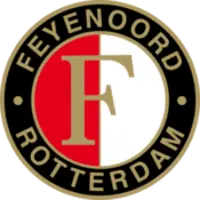
Historical Crests Feyenoord Rotterdam
Name: Feyenoord Rotterdam
Nickname(s): The Stadium Club, The Club of the People, The Pride of the South
Founded: 1908
Stadium: De Kuip (Rotterdam)
Capacity: 51,117
Feyenoord Crest History
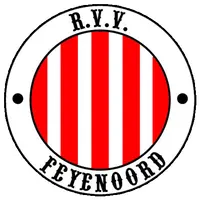
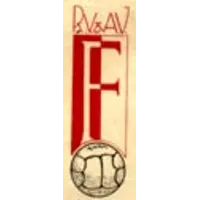
The club was founded in 1908 as Wilhelmina and initially used simple monograms and text-based emblems typical of early football clubs. Following several name changes, including periods as HFC and Celeritas, the club eventually adopted the name Feijenoord in 1912, referencing the Rotterdam district from which it originated.
As the club established itself as a major force in Dutch football during the early twentieth century, more formal badge designs began to appear. These early crests generally featured the club initials and incorporated the red-and-white colours that would become synonymous with Feijenoord.
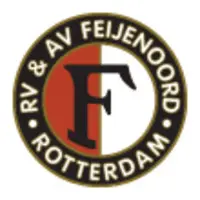
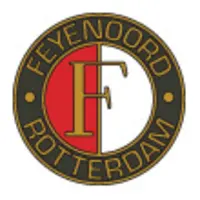
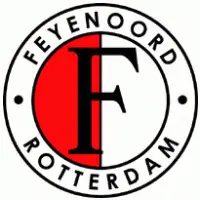
The defining moment in the club's visual history arrived when the famous circular crest was introduced. The badge featured a red-and-white divided circle with a bold gold or black "F" at its centre. The design was simple, distinctive and highly effective, quickly becoming one of the most recognisable football logos in Europe.
Throughout the 1930s, 1940s and 1950s, only minor refinements were made to the emblem. The circular shape remained unchanged, while adjustments were occasionally made to colours, borders and typography. The badge accompanied the club through numerous domestic successes and became firmly established as the symbol of Rotterdam football.
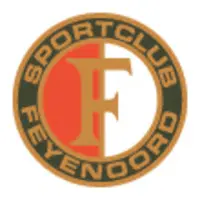
In 1974, the club officially changed the spelling of its name from Feijenoord to Feyenoord, making it easier for international audiences to pronounce. Despite the change in name, the crest itself remained largely untouched, demonstrating the strength and popularity of the existing design.
Throughout the 1980s and 1990s, Feyenoord continued to use the traditional circular badge. During this period, the crest became associated with legendary players such as Johan Cruyff, Ruud Gullit, John de Wolf and Giovanni van Bronckhorst, as well as major domestic and European successes.
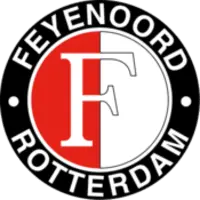
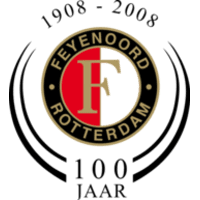
A modernised version of the crest was introduced in the early 2000s. The redesign refined the proportions, enhanced the gold detailing and improved the overall balance of the emblem while preserving its historic appearance. The changes were subtle and intended to modernise the logo without altering its identity.
The current crest remains faithful to the traditional design. The red-and-white circle, the central F, and the gold detailing continue to form the foundation of the badge, making it one of the least altered and most enduring crests in world football.
Feyenoord Club History
Founded on 19 July 1908, Feyenoord is one of the most successful and influential football clubs in the Netherlands. Established in the working-class district of Feijenoord in southern Rotterdam.
The club began life as Wilhelmina, before changing its name several times and eventually becoming Feijenoord in 1912. Around the same period, the club adopted its now-famous red-and-white colours, which would become one of the most recognisable identities in European football.
Feyenoord steadily rose through Dutch football during the early twentieth century and won its first Dutch championship in 1924. The title marked the beginning of the club's emergence as a national force and established Rotterdam as a major football city.
During the 1930s and 1940s, Feyenoord became one of the strongest clubs in the Netherlands, winning multiple league titles and building a large and passionate supporter base. The club's popularity expanded well beyond Rotterdam and throughout the country.
The post-war years brought further success. Feyenoord continued to compete at the highest level and became one of the leading clubs following the introduction of professional football in the Netherlands in 1954.
The greatest period in the club's history arrived during the late 1960s and early 1970s. Under legendary coach Ernst Happel, Feyenoord assembled one of the strongest teams ever seen in Dutch football. Players such as Willem van Hanegem, Coen Moulijn, Rinus Israël and Ove Kindvall helped transform the club into a European powerhouse.
In 1970, Feyenoord made history by becoming the first Dutch club to win the European Cup, defeating Celtic in the final. Later that year, the club also won the Intercontinental Cup, becoming world champions and placing Dutch football firmly on the global stage.
Another major European success followed in 1974, when Feyenoord won the UEFA Cup, confirming its status as one of Europe's elite clubs.
Throughout the 1980s, Feyenoord remained one of the leading clubs in Dutch football. One of the most famous moments of the decade came when Johan Cruyff joined the club for the 1983–84 season. Cruyff helped Feyenoord secure a memorable league and cup double before retiring from professional football.
The club enjoyed another successful era during the 1990s under coach Willem van Hanegem and later Leo Beenhakker. Feyenoord regularly challenged for domestic honours and consistently qualified for European competitions.
A historic achievement arrived in 2002, when Feyenoord won the UEFA Cup for the second time. Playing the final in their own stadium, De Kuip, the club defeated Borussia Dortmund to secure one of the most celebrated victories in its history.
A revival began under coach Giovanni van Bronckhorst, culminating in the 2016–17 Eredivisie title. The championship ended an eighteen-year wait for a league title and sparked huge celebrations throughout Rotterdam.
The success continued in the following years with additional domestic trophies and a return to European competitiveness. Under coach Arne Slot, Feyenoord won the 2022–23 Eredivisie title and re-established itself as one of the strongest clubs in Dutch football.
In 2022, Feyenoord also reached the inaugural UEFA Europa Conference League Final, further demonstrating the club's resurgence on the European stage.
Feyenoord plays its home matches at Stadion Feijenoord, universally known as De Kuip ("The Tub"). Opened in 1937, it is one of the most iconic stadiums in European football and remains a symbol of the club's identity and traditions.
The club's fiercest rivalry is with Ajax in De Klassieker, the biggest match in Dutch football. The rivalry reflects not only sporting competition but also the cultural differences between Rotterdam and Amsterdam. Strong rivalries also exist with Sparta Rotterdam and FC Utrecht.
Feyenoord Rotterdam
Your Dynamic Snippet will be displayed here... This message is displayed because you did not provide enough options to retrieve its content.