Skip to Content

Historical Crests FC Crotone

Name: FC Crotone
Nickname(s): I Pitagorici (The Pythagoreans), Gli Squali (The Sharks)
Founded: 1910
Stadium: ​Stadio Ezio Scida (Crotone)
Capacity: ​16,647

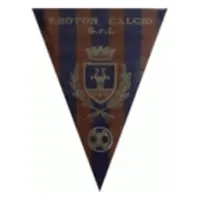
1986-1991
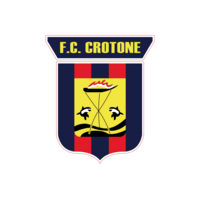
2000-2005
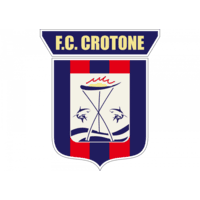
2005-2012
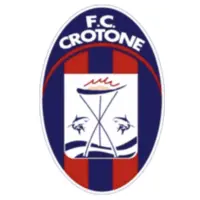
2012-Present

FC Crotone Crest History
Throughout its history, FC Crotone's crests have remained closely tied to three symbols: the club's red-and-blue colours, the ancient Greek heritage of the city of Crotone and the shark, which eventually became the defining emblem of the club and inspired its famous nickname, Gli Squali ("The Sharks"). 
For much of the twentieth century, the club's visual identity was heavily influenced by the coat of arms of the city of Crotone
A major change arrived in 1986, following one of the club's reorganisations and the adoption of the name Associazione Kroton Calcio. For the first time, the club moved away from simply reproducing the city's coat of arms and introduced a distinctive football crest of its own. The new badge took the form of a three-pointed pennant featuring the city emblem above a football, while red-and-blue striped elements reinforced the club's traditional colours. The use of "Kroton," the ancient Greek name of the city, highlighted Crotone's connection to Magna Graecia and its rich historical heritage.
Throughout the late 1980s and 1990s, the crest continued to evolve as the club climbed through the Italian football pyramid. 
One of the most important developments occurred during the late 1990s, when the shark began to appear prominently within the club's identity. The symbol quickly became popular among supporters and gave rise to the nickname Gli Squali. The shark reflected both the club's fighting spirit and its location on the Ionian coast, creating a powerful image that set Crotone apart from many other Italian clubs.
A major redesign arrived in 2000, shortly after the club achieved its first-ever promotion to Serie B. The traditional pennant was replaced by a modern shield featuring a pointed base and rounded edges. A banner displaying the club's name appeared at the top, while the centre of the badge incorporated the city's historic symbols. Most importantly, the crest prominently featured two sharks surrounding a tripod, one of the most important symbols of ancient Kroton.
The tripod was not chosen by chance. It is closely associated with the city's Greek origins and references the importance of Crotone within Magna Graecia. By combining the tripod with the sharks, the club successfully united its ancient heritage with its modern football identity.
In 2005, the badge underwent a refinement rather than a complete redesign. The overall structure remained largely unchanged, but the colours were softened and the graphic elements modernised. The sharks and tripod remained central to the composition, ensuring continuity with the identity established at the beginning of the decade.
Another important update arrived in 2012. The shield adopted a more elegant and balanced shape while retaining all the core elements introduced in 2000. The sharks continued to flank the central tripod, while the club name became more prominent within the design. This version of the crest accompanied the club through the most successful period in its history, including its historic promotions to Serie A.
The modern badge successfully combines all the symbols that define FC Crotone. The red-and-blue colours reflect the club's traditional identity, the tripod celebrates the city's ancient Greek origins, and the two sharks represent determination, resilience and the strong connection to the Ionian Sea.

FC Crotone Club History
The club was founded in 1910 as Milone Crotone, although the modern organisation traces its origins through a series of mergers and reorganisations that eventually led to the creation of Football Club Crotone in 1979. For much of the twentieth century, football in Crotone remained a regional affair, with the club competing in Calabria's local championships and the lower levels of the Italian football pyramid.
A turning point arrived during the 1980s when Crotone began establishing itself within the national league system. The club gradually climbed through the divisions and developed a reputation as an ambitious provincial side determined to represent Calabria on a larger stage.
The 1990s proved transformative. Under the presidency of Raffaele Vrenna, who would become one of the most influential figures in the club's history, Crotone experienced a period of unprecedented growth. Promotions through Serie C2 and Serie C1 followed, and the club steadily moved closer to the upper levels of Italian football.
The breakthrough came in 2000, when Crotone achieved promotion to Serie B for the first time in its history. For a club that had spent decades in the lower divisions, reaching the second tier represented a monumental achievement and signalled the arrival of a new force in southern Italian football.
One of the most important aspects of Crotone's development was its close relationship with larger clubs, particularly Juventus. Through intelligent recruitment and loan agreements, Crotone became known for nurturing promising young players while remaining competitive in one of Europe's most demanding second divisions.
The greatest achievement in the club's history arrived in 2016. Under coach Ivan Jurić, Crotone secured promotion to Serie A for the first time ever. The achievement was celebrated throughout Calabria. A city of just over 60,000 inhabitants had succeeded in reaching the highest level of the Italian game.
Crotone's debut Serie A season produced one of the most dramatic survival stories ever seen in the league. At one stage during the 2016–17 campaign, the club appeared certain to be relegated. However, an extraordinary late-season run saw Crotone overturn a seemingly impossible points deficit and secure survival on the final day. The achievement became known throughout Italy as the Miracle of Crotone and remains one of the club's proudest moments.
Although relegation followed in 2018, Crotone quickly demonstrated its resilience. The club returned to Serie A in 2020 after securing promotion from Serie B under coach Giovanni Stroppa. Once again, one of Italy's smallest professional clubs had reached the top flight through careful planning and strong performances on the pitch.
FC Crotone plays its home matches at the Stadio Ezio Scida, named after one of the club's most important historical figures. The stadium has become a symbol of the club's rise and hosted some of the most memorable moments in its history, including its first Serie A campaigns.
The club's most significant rivalry is with Catanzaro, a fixture that reflects the long-standing competition between two of Calabria's most important football cities. Other notable rivalries exist with Cosenza and Reggina, creating some of the most passionate derby matches in southern Italian football.