Skip to Content

Historical Crests Como 1907

Name: Como 1907
Nickname(s): ​I Lariani (The Larians)
Founded: 1907
Stadium: ​Stadio Giuseppe Sinigaglia (Como)
Capacity: ​​13,602

1926-1936
1950-1980
1980-1992
1992-2016
2017
2017-2020
2020-Present

Como 1907 Crest History
Throughout its history, the club's crests have remained closely tied to two symbols: the coat of arms of the city of Como and the waters of Lake Como, which have shaped the city and its culture for centuries. 
The earliest known crest, used during the 1920s, reflected the traditions of early Italian football. The 1926 badge featured the city's heraldic cross and civic symbolism, establishing a connection between the football club and the city it represented. Around this period, following the merger with local rivals Esperia and the creation of Associazione Calcio Comense, the club began placing greater emphasis on municipal symbols within its visual identity.
By 1950, Como adopted a new crest that would become one of the most recognisable in the club's history. The badge took the form of a blue shield featuring the club name and the red-and-white cross from the city's coat of arms. The use of blue became increasingly prominent, reflecting the club's traditional colours and helping establish the identity that supporters would come to associate with Como throughout the twentieth century.
In 1980, Como abandoned the traditional shield format and introduced one of the most distinctive badges in its history. The new emblem featured a stylised blue swallow in flight above the club's name, accompanied by the red-and-white cross from the city coat of arms. The bird is significant because Como's supporters have long been associated with the nickname I Lariani, referencing Lake Como (Lario), but the swallow itself symbolises movement, freedom and elegance. The crest became closely associated with one of the club's most successful periods, including several seasons in Serie A during the 1980s.
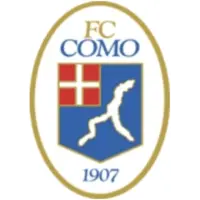
A major redesign arrived in 1992. The traditional shield was replaced by a more distinctive emblem centred around a white ancile-shaped shield containing the coat of arms of Como. Blue wave motifs were introduced on either side of the city's cross, representing the waters of Lake Como for the first time in a prominent way. The club's name appeared above the emblem, while the foundation year was placed below.
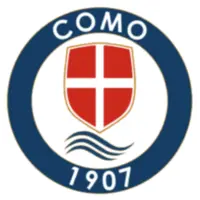
Following the bankruptcy and rebirth of the club in 2017, Como entered a period of visual transition. The first 2017 crest reflected the establishment of the new organisation and sought to maintain continuity with the club's heritage. A second version followed shortly afterwards as the newly formed Como 1907 refined its branding and identity. Both designs retained references to the city's historic cross and the club's traditional blue colours while adapting to the realities of a new era.
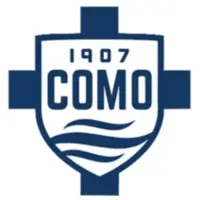
The most dramatic change in the club's history arrived in 2020. Following the takeover by new ownership, Como introduced a completely modernised crest unlike any used before. Rather than relying primarily on the city's coat of arms, the new badge adopted a minimalist design featuring stylised blue lake waves superimposed over a cross. The red element traditionally associated with Como's civic heraldry disappeared entirely, creating a monochromatic blue identity. The result was a clean and contemporary logo designed to reflect both the club's ambitions and the international appeal of Lake Como.
The 2020 crest represented a significant departure from tradition and generated considerable debate among supporters. Some appreciated its modern aesthetic and strong connection to the lake, while others missed the more prominent display of the city's historic coat of arms. Regardless of opinion, the redesign marked the beginning of a new chapter in Como's history as the club embarked on its remarkable rise back to Serie A.

Como 1907 Club History
Founded in 1907 as Como Foot-Ball Club, the club represents the city of Como and the shores of the famous Lake Como. Throughout its history, Como has been known for its royal blue colours, earning the nickname I Lariani, a reference to Lake Como's ancient Roman name, Larius.
The club quickly established itself within the early Italian football system and made its first appearance in the top division during the 1913–14 season
A major chapter in the club's history began in 1927 when Como merged with local rivals Esperia and became Associazione Calcio Comense. During this period, the club moved into the newly built Stadio Giuseppe Sinigaglia, which remains its home today. Named after war hero and Olympic rower Giuseppe Sinigaglia, the stadium occupies one of the most picturesque locations in world football, situated directly on the shores of Lake Como.
One of the club's most successful periods arrived during the 1970s and 1980s. Promotion to Serie A in 1975 brought Como back among Italy's elite, and although relegation soon followed, the club quickly returned. The greatest era in the club's history came during the mid-1980s when Como enjoyed a five-year stay in Serie A. Led by players such as Stefano Borgonovo and Dan Corneliusson, the club achieved consecutive ninth-place finishes and established itself as one of the strongest provincial sides in Italy.
The 1990s proved more difficult. Relegations gradually pushed Como down the football pyramid, and financial instability began to affect the club. 
A remarkable revival occurred at the beginning of the twenty-first century. Under coach Loris Dominissini, Como achieved back-to-back promotions from Serie C1 to Serie A between 2001 and 2003. For the first time in over a decade, the club returned to the highest level of Italian football and appeared poised to establish a new era of success.
However, the dream quickly turned into a nightmare. Como's return to Serie A lasted only one season, and financial problems soon overwhelmed the club. Consecutive relegations followed, culminating in bankruptcy in 2004. The collapse forced Como to restart from amateur football, beginning one of the most turbulent periods in its history.
Although the club gradually climbed back through the divisions and returned to professional football, stability remained elusive. Further financial difficulties culminated in a second bankruptcy in 2016, forcing another restart and threatening the future of one of Lombardy's oldest football institutions.
A new chapter began in 2017 when the club was re-established as Como 1907 and admitted to Serie D. While the immediate objective was survival, the foundations were being laid for one of the most remarkable transformations in modern European football.
The turning point arrived in 2019, when London-based SENT Entertainment, backed by Indonesian billionaires Robert and Michael Hartono through the Djarum Group, acquired the club. The new ownership inherited a team competing in Serie D but immediately implemented an ambitious long-term project focused on financial stability, infrastructure, youth development and sporting success.
Success arrived quickly. Como won Serie D in 2019, secured promotion to Serie C, then captured the Serie C title in 2021 to return to Serie B. After several years of steady progress, the club achieved its greatest modern objective in 2024 by securing promotion to Serie A for the first time in twenty-one years. The achievement completed a remarkable rise from the fourth tier to the top flight in just five seasons.
The new era also attracted global attention. Former world-class players such as Cesc Fàbregas, Thierry Henry and Dennis Wise became involved in the project in various roles, helping raise the club's international profile. Fàbregas later moved into coaching and became one of the central figures in Como's resurgence.
Beyond football, the club's owners pursued a broader vision built around the global image of Lake Como. Investments in branding, tourism, hospitality and lifestyle partnerships transformed Como into one of the most talked-about projects in European football. 
Historically, Como's most significant rivalry is with Lecco. Matches between the two sides are known as the Derby del Lario, named after Lake Como itself, and represent one of the fiercest rivalries in Lombardy. Other notable rivalries exist with Varese and Monza.