Skip to Content

Historical Crests Cesena FC

Name: Cesena FC
Nickname(s): ​I Cavallucci Marini (The Seahorses)
Founded: ​1973
Stadium: Stadio Dino Manuzzi (Cesena)
Capacity: ​​23,860

19??-197?
197?-1975
1975-2000
2000-2018
2018
2018
2018-Present

Cesena FC Crest History
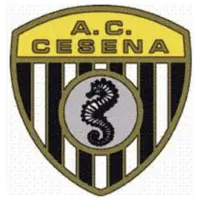
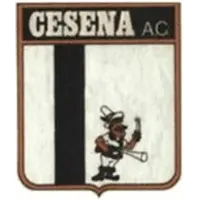
The badges used until 1975 reflected this traditional approach. It prominently featured the club's name and black-and-white colours while maintaining a conventional shield format. 
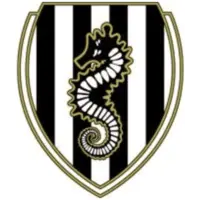
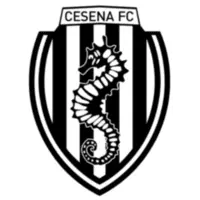
A major transformation arrived in 1975, shortly after the club's first experiences in Serie A. The new crest introduced the symbol that would become synonymous with Cesena football: the seahorse. Designed by renowned Italian graphic artist Piero Gratton, who also created several famous football emblems and national team identities, the stylised seahorse immediately gave Cesena one of the most distinctive badges in Italy. The symbol was inspired by the Adriatic coastline of Romagna and quickly became a beloved emblem among supporters.
The seahorse design proved enormously successful and remained at the heart of Cesena's visual identity for the next quarter century. More than simply a logo, it became the club's defining symbol and gave rise to the nickname I Cavallucci Marini. For many supporters, the seahorse represented the most iconic era of Cesena's history, including memorable seasons in Serie A and the club's growing reputation within Italian football.
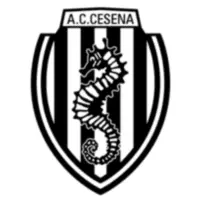
In 2000, the badge underwent a redesign. While the seahorse remained central to the crest, the overall design was modernised. The shield shape was updated, typography was refined and the emblem was adapted to contemporary branding standards. Despite these changes, the club carefully preserved the seahorse, recognising its importance to Cesena's identity and its popularity among supporters.
The collapse of AC Cesena in 2018 marked the beginning of a new chapter in the club's visual history. Following the bankruptcy of the original organisation, a successor club was established to continue football in the city. During this transitional period, several different crests appeared in rapid succession. These temporary crests represented the uncertainty of the transition period and were only used briefly.
Later in 2018, a definitive crest was introduced. This design restored the black-and-white colours and re-established the seahorse as the club's primary symbol. By returning to the iconic Cavalluccio Marino, the new Cesena FC signalled its intention to preserve the heritage and identity of the club that supporters had followed for generations.


Cesena FC Club History
Founded in 1940 as Associazione Calcio Cesena. Throughout its history, Cesena has been known by two famous nicknames: I Bianconeri ("The White and Blacks") and I Cavallucci Marini ("The Seahorses").
Cesena established itself as an ambitious provincial side and earned promotion to Serie B in 1968, laying the foundations for the most successful period in its history.
The club's breakthrough arrived in 1973 when Cesena achieved promotion to Serie A. The golden era of Cesena football came during the mid-1970s. In the 1975–76 season, the club achieved a remarkable sixth-place finish in Serie A, still the highest league position in its history. 
Throughout the 1980s and 1990s, Cesena became known as one of Italy's classic "yo-yo clubs," alternating between Serie A and Serie B.
A significant revival occurred during the late 2000s and early 2010s. Under the management of Pierpaolo Bisoli. After relegation in 2012, Cesena once again demonstrated its resilience by securing promotion back to Serie A through the play-offs in 2014. 
Throughout its history, Cesena played its home matches at the Stadio Dino Manuzzi.
A dramatic turning point arrived in 2018 when financial difficulties led to the bankruptcy and dissolution of the original AC Cesena after seventy-eight years of existence. The collapse ended the legal existence of the club that had represented the city since 1940 and shocked supporters across Italy.
Football in Cesena survived thanks to the creation of Cesena FC, a successor organisation established through the transformation of nearby Romagna Centro. Beginning again in Serie D, the new club immediately adopted the colours, traditions, stadium and identity of historic Cesena. The reborn club back into the professional ranks.
The recovery continued throughout the early 2020s, culminating in a return to Serie B. Although legally a new organisation, Cesena FC is widely regarded by supporters as the continuation of the footballing tradition established in 1940, preserving the heritage and identity of one of Emilia-Romagna's most beloved clubs.
Cesena's most important rivalry is with Bologna FC 1909. Encounters between the two clubs are often considered one of the most significant fixtures in Emilia-Romagna, reflecting the historic competition between their cities. Other notable rivalries exist with Rimini FC, Modena FC and SPAL.

Cesena FC Pins

Your Dynamic Snippet will be displayed here... This message is displayed because you did not provide enough options to retrieve its content.