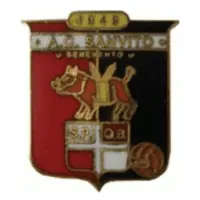
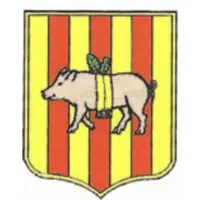
The earliest Benevento badges were relatively simple and followed the conventions of Italian football during the mid-twentieth century. These designs generally featured the club's name and colours, helping establish an identity for the team while maintaining a connection to the city it represented. As the club grew in stature, more distinctive local symbols began to appear within the crest.
The colours yellow and red became central to the club's visual identity and remain the defining feature of every major badge. These colours earned the club the nickname Giallorossi ("The Yellow and Reds"), a title shared with a few other Italian clubs but closely associated with Benevento throughout southern Italy.
A unique aspect of Benevento's identity comes from the city's long-standing association with witches. For centuries, Benevento has been linked to legends of witches gathering beneath a sacred walnut tree along the banks of the Sabato River. These stories became deeply embedded in local folklore and eventually influenced the football club's symbolism. As a result, Benevento supporters often refer to their team asLe Streghe ("The Witches"), one of the most unusual nicknames in Italian football.
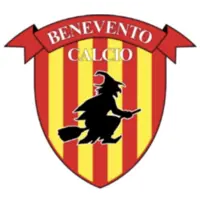
As Benevento developed into a more prominent professional club, the badge became increasingly sophisticated. The witch symbol gradually emerged as the most distinctive feature of the club's identity. Rather than depicting a frightening figure, the crest typically presented a stylised and elegant interpretation of the witch legend, transforming a piece of local folklore into a positive and recognisable sporting symbol.
The most influential modern versions of the crest combined several important elements: the club's yellow-and-red colours, the name Benevento and a witch riding a broomstick. The broomstick became a particularly important symbol because it immediately distinguished Benevento from every other club in Italy and reinforced the nickname Le Streghe. Few football clubs anywhere in the world possess a crest so directly connected to local folklore.
Throughout the 2000s and 2010s, the badge underwent several refinements as Benevento climbed through the Italian football pyramid. Designers modernised the artwork, improved readability and created a cleaner visual appearance while preserving the essential symbolism. The witch remained central to every redesign, ensuring continuity as the club progressed from the lower divisions to national prominence.
Following Benevento's historic promotion to Serie A in 2017, the crest gained international visibility for the first time.
Benevento Calcio Club History
Benevento Calcio is one of the most prominent football clubs in southern Italy and the leading sporting institution of the city of Benevento in the Campania region.
The club was founded in 1929 and spent the majority of its early history competing in regional and lower-division football.
Throughout its history, Benevento has been closely associated with the colours yellow and red, earning the nickname Giallorossi ("The Yellow and Reds"). However, the club is perhaps better known by another nickname: Le Streghe ("The Witches").
A turning point arrived during the 2000s when new investment and improved organisation helped stabilise the club. Benevento began building a more ambitious sporting project and gradually emerged as one of the strongest sides in the lower professional divisions. The club's progress accelerated significantly during the 2010s.
The most remarkable chapter in Benevento's history began in 2016 when the club achieved promotion to Serie B for the first time. The achievement represented a historic milestone for both the club and the city. What followed exceeded even the most optimistic expectations. In the 2016–17 season, Benevento secured a second consecutive promotion, reaching Serie A for the first time in its history after defeating Carpi FC in the promotion play-offs.
Promotion to Serie A was one of the most extraordinary achievements in modern Italian football. A club that had never previously played above the second division suddenly found itself competing against the country's traditional giants. Benevento's debut top-flight season attracted national attention, although the campaign proved challenging. The club famously lost its first fourteen league matches before earning its first Serie A point through a dramatic last-minute equalising goal scored by goalkeeper Alberto Brignoli against AC Milan. The moment became one of the most memorable stories of the season and remains iconic in Benevento's history.
The club plays its home matches at the Stadio Ciro Vigorito, named after a former club president who played a crucial role in Benevento's development. The stadium became a symbol of the city's footballing renaissance during the club's rise through the divisions and its historic seasons in Serie A.
Benevento's most significant rivalry is with US Avellino 1912. Matches between the two clubs are known as the Derby della Campaniaand are among the most passionate fixtures in southern Italian football. The rivalry reflects the close geographical proximity of the cities and a long-standing competition for regional football supremacy. Other notable rivalries exist with US Salernitana 1919 and SSC Napoli, though the Avellino fixture remains the most emotionally significant for many supporters.