Historical Crests AZ Alkmaar
Name: AZ Alkmaar
Nickname(s): The Cheese Farmers
Founded: 1967
Stadium: Afas Stadium
Capacity: 17,023
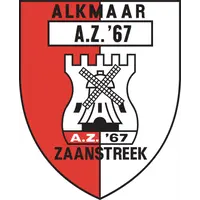
1967-1980
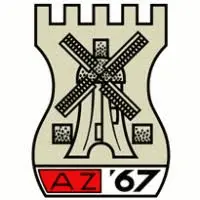
1980-1986
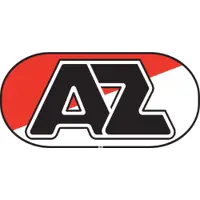
1986-Present
AZ Alkmaar Crest History
Throughout its history, AZ's crest has reflected the club's origins as a merger between Alkmaar '54 and FC Zaanstreek.
The first crest, introduced in 1967 following the merger that created AZ '67, featured a traditional shield incorporating a tower and a windmill. The tower represented the city of Alkmaar, while the windmill symbolised the Zaan region and FC Zaanstreek. The badge also displayed the name AZ '67, highlighting the year in which the club was formed.
A simplified version of the emblem appeared around 1980, reducing some of the decorative elements while retaining the tower, windmill and AZ lettering. This badge became closely associated with AZ's golden era and remains highly regarded among supporters.
A major redesign arrived in 1986. After the club dropped the "'67" from its official name, AZ abandoned the traditional tower-and-windmill crest and introduced a completely new visual identity. The new badge featured a bold AZ monogram placed inside an oval divided diagonally into red and white halves. The clean and modern design reflected contemporary branding trends while symbolising the unity between Alkmaar and Zaanstreek.
AZ Alkmaar Club History
Founded in 1967 through the merger of Alkmaar '54 and FC Zaanstreek, AZ (Alkmaar Zaanstreek). The club initially competed under the name AZ '67, with the year commemorating its foundation.
A transformation began in the 1970s under the ownership of brothers Cees and Klaas Molenaar, whose investment helped turn AZ into one of the strongest clubs in the country.
The most successful period in the club's history came at the end of the decade and the beginning of the next. During the 1980–81 season, AZ achieved a historic league and cup double, winning the Eredivisie title and the KNVB Cup. The championship remains one of the greatest achievements in Dutch football history, as it broke the near-monopoly of the traditional "Big Three."
That same season, AZ also reached the UEFA Cup Final, defeating several major European clubs before eventually losing to Ipswich Town. The run remains one of the finest European campaigns ever achieved by the club and established AZ as a respected name beyond the Netherlands.
Following the departure of the Molenaar family and financial difficulties during the 1980s, AZ entered a period of decline. The club suffered relegation and spent several years outside the top flight, struggling to recapture the success of its golden era.
A revival began during the 1990s, and AZ eventually returned to the Eredivisie. The club gradually rebuilt its reputation and laid the foundations for a new period of growth.
The arrival of businessman Dirk Scheringa marked another important turning point. Significant investment improved the club's infrastructure, youth development and sporting ambitions. AZ became one of the best-organised clubs in the Netherlands and regularly challenged for European qualification.
Under coach Co Adriaanse, AZ emerged as a major force during the early 2000s. The team played attractive attacking football and narrowly missed out on reaching the UEFA Cup Final in 2005, losing dramatically to Sporting CP in the semi-finals.
Another historic achievement followed under legendary coach Louis van Gaal. During the 2008–09 season, AZ won its second Eredivisie championship, ending a 28-year wait for another league title. Built around players such as Mounir El Hamdaoui, Mousa Dembélé, Stijn Schaars and Sergio Romero, the team dominated Dutch football and secured a memorable championship.
Many notable players have emerged from or developed at AZ, including Teun Koopmeiners, Tijjani Reijnders, Myron Boadu, Owen Wijndal, Joris Mathijsen, Jozy Altidore and Vincent Janssen.
The opening of the AFAS Stadion in 2006 provided AZ with one of the most modern football venues in the Netherlands. The stadium became a symbol of the club's ambition and long-term planning.
AZ's main rivalries are with fellow North Holland clubs Ajax and FC Volendam, while matches against Feyenoord and PSV Eindhoven are often crucial in the battle for European places and domestic honours.
AZ Alkmaar Pins
Your Dynamic Snippet will be displayed here... This message is displayed because you did not provide enough options to retrieve its content.