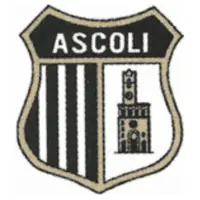
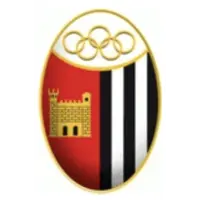
In the club's earliest years, Ascoli used relatively simple emblems and monograms, a common practice among Italian football clubs during the first half of the twentieth century.
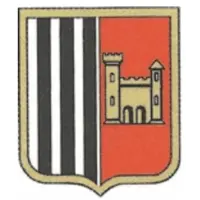
The most important influence on the club's crest became the municipal coat of arms of Ascoli Piceno. The city has a long and distinguished history dating back to Roman times, and its heraldic symbols provided a natural foundation for the football club's visual identity.
Ascoli's famous black-and-white colours also became central to the crest. These colours have represented the club throughout its history and are among the most recognisable aspects of its identity. The monochrome palette earned the team the nicknameI Bianconeri ("The Black and Whites"), a designation shared with a few other historic Italian clubs but particularly associated with Ascoli in central Italy.
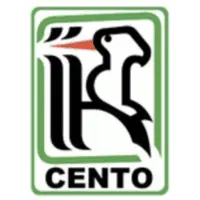
One of the most distinctive symbols to appear on former Ascoli crests was the woodpecker. Known in Italian as the Picchio, the bird is closely associated with the region and became one of the club's most famous nicknames. The woodpecker holds particular significance in Piceno history and folklore, where it is considered a symbol of the ancient Piceni people who inhabited the area before Roman rule.
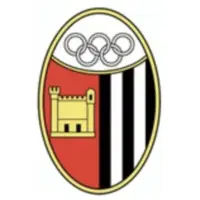
During the latter half of the twentieth century, particularly during the club's most successful years under legendary president Costantino Rozzi, the badge underwent several refinements. These updates generally focused on modernising the artwork while preserving the essential connection to the city and the club's colours. Different shield shapes and graphic styles were introduced, but the emphasis on civic symbolism remained constant.
As football branding became increasingly important in the modern era, Ascoli adopted cleaner and more professional crest designs. The woodpecker gradually disappeared from the primary badge, although it remained an important symbol within the club's culture and supporter traditions. The focus shifted towards a more heraldic representation of the city and club identity.
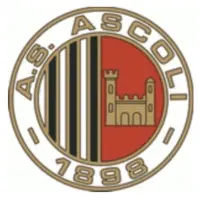
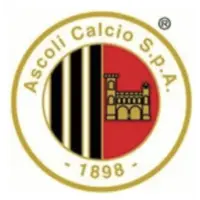
The modern crest prominently displays the coat of arms of Ascoli Piceno, reinforcing the club's deep connection to its hometown. The black-and-white colours remain central to the design, while the club's name is clearly incorporated into the badge. The crest also includes the green, white and red colours of the Italian flag, symbolising both national pride and the club's place within Italian football. Completing the design is the year of foundation, 1898, highlighting Ascoli's status as one of the oldest football clubs in the country.
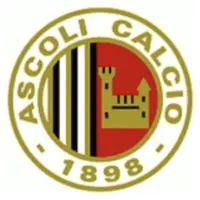
In 2026, Ascoli Calcio introduced a comprehensive rebranding that marked the club's first major visual identity update in several years. The new crest revived the historic circular shape associated with the club's most successful period under Costantino Rozzi, while incorporating the Armilla Picena into the inner ring as a tribute to the city's ancient heritage. The Cassero was redesigned with greater historical accuracy and enriched with references to Ascoli Piceno as the "City of a Hundred Towers" and the "Queen of the Marche". The traditional black-and-white stripes returned with their historic yellow pinstripe, and the colour palette was revised to reflect local symbols, including the city's travertine stone, municipal colours and the basil associated with the patron saint, Sant'Emidio.
Ascoli Calcio 1898 FC Club History
Ascoli Calcio 1898 FC is one of the oldest football clubs in Italy and based in the city of Ascoli Piceno in the Marche region.
The club was founded in 1898 under the name Candido Augusto Vecchi, making it one of the earliest football organisations in the country. As football became more structured in Italy, the club underwent a series of name changes that reflected its evolution. In 1905 it became Ascoli Vigor, before adopting the name US Ascolana in 1921. Following the Second World War, the club was reorganised as AS Ascoli in 1945, a name it would carry for several decades.
Throughout its early history, Ascoli established itself as the principal football club of Ascoli Piceno and became closely associated with its traditional black-and-white striped shirts. These colours have remained a constant throughout the club's existence and earned the team the nickname I Bianconeri ("The Black and Whites"). The vertical black-and-white stripes remain one of the most recognisable features of the club's identity.
A pivotal moment in Ascoli's history occurred in 1955 when the club faced severe financial difficulties and the threat of bankruptcy. It was rescued by publishing magnate Cino Del Duca, one of the most influential figures in the city's history. Del Duca merged AS Ascoli with his own football team, creating Del Duca Ascoli. His intervention not only saved the club but also laid the foundations for future success. In recognition of his contribution, the club's stadium was later named the Stadio Cino e Lillo Del Duca, honouring both Cino and his brother Lillo.
The club continued to grow during the 1960s and reached its greatest period of success under the presidency of the legendary Costantino Rozzi. In 1971, the club adopted its current name, Ascoli Calcio 1898, a title that emphasised its long and distinguished history.
The 1970s and 1980s represented the golden era of Ascoli football. Guided by Rozzi and managed for much of this period by the influential coach Carlo Mazzone, Ascoli rose through the divisions and established itself as a competitive Serie A club. The team's promotion to the top flight transformed the club into one of the most respected provincial sides in Italy.
Ascoli's most successful years came during the late 1970s and early 1980s, when the club regularly competed in Serie A and challenged many of Italy's traditional powers. Remarkably, Ascoli became one of the smallest cities ever represented consistently in the top division of Italian football.
Rivalries have always played a major role in Ascoli's history. The club's most traditional derby is against US Sambenedettese. Known simply as the Marche Derby, this fixture is fuelled by intense local pride and a long-standing rivalry between the cities of Ascoli Piceno and San Benedetto del Tronto. Although the last league meeting between the two clubs occurred in 1986, the rivalry remains deeply felt by supporters and continues to be one of the most passionate in the region.
Another major rivalry exists with Ancona. Historically, Ascoli and Ancona have been the two most successful clubs in the Marche region, and matches between them have often been viewed as a battle for regional supremacy. The rivalry extends beyond football and is rooted in history. While Ancona is the modern capital of Marche, Ascoli Piceno, known in Roman times as Asculum, was the capital of ancient Picenum. This historical competition has contributed to a fierce struggle for the title of La Regina delle Marche ("The Queen of Marche"), adding further significance to encounters between the two clubs.