Skip to Content

Historical Crests AC Monza

Name: ​AC Monza
Nickname(s): ​I Biancorossi
Founded: 1912
Stadium: ​Stadio Brianteo (Monza)
Capacity: ​​15,039

2000-2004
2004-2013
2013-2015
2015-2016
2016-2019
2019-Present

AC Monza Crest History
One symbol has remained central during the years to the AC Monza's identity: the Corona Ferrea (Iron Crown of Lombardy), one of the most important historical relics associated with the region.
Monza's first official crest appeared in 1920. The badge featured a blue shield bordered in red, with a golden Corona Ferrea positioned at its centre. Across the top of the shield ran a white horizontal band containing the inscription "A.C. Monza" in black lettering. The Iron Crown was a natural choice for the club, as it is housed in the city's cathedral and has long been one of Monza's most significant historical symbols. This crest remained in use until 1932.
A major change occurred in 1933 when the club adopted its now-famous red-and-white colours. The badge became circular and was vertically divided into red and white halves. Golden initials "A.C.M." appeared prominently within the design, while the Corona Ferrea was placed at the bottom of the emblem. The redesign strengthened the connection between the badge and the club's evolving visual identity.
During the 1937–38 season, the crest's shape changed from a circle to an oval while preserving the same essential elements. The red-and-white division, initials and Iron Crown remained intact. This version survived until the end of the Second World War, demonstrating a level of stability unusual for the club's otherwise frequently changing visual identity.
Following the war, Monza adopted a rectangular crest divided into red and white sections. The white half displayed the club's name and founding year, while the Corona Ferrea occupied the red half. This redesign reflected broader post-war trends in Italian football, with clubs often seeking cleaner and more modern badge designs.
After promotion to Serie B in 1951, Monza introduced another oval crest. The orientation of the text was altered from vertical to horizontal, creating a more balanced composition. This version remained in use for five years before one of the most unusual episodes in the club's history.
In 1955, Monza merged with the food company-backed Simmenthal organisation and became Simmenthal-Monza. The crest adopted during this period was unlike any previous badge. Shaped like an ox's head, it incorporated horns at the top and featured diagonal red-and-white colour divisions. The initials "S" and "M" were superimposed at the centre, representing Simmenthal and Monza respectively, while the Corona Ferrea remained above them. This distinctive badge symbolised one of the most unique partnerships in Italian football.
When the merger ended in 1966, Monza returned to a more traditional identity. The crest became a stylised golden Corona Ferrea with red detailing. The club's name was incorporated into the inner circle, making the Iron Crown itself the primary focus of the badge. This represented perhaps the purest expression of Monza's connection to the city's historical heritage.
Another significant redesign arrived in 1984. The badge adopted a rectangular shape containing a large white inverted chevron. The words "Calcio" and "Monza" were placed on either side, while a vertical sword occupied the downward-pointing triangle formed by the chevron. The sword referenced Estorre Visconti, while the Corona Ferrea formed the sword's hilt. This was one of the first occasions when Monza combined two important local historical symbols within a single crest.
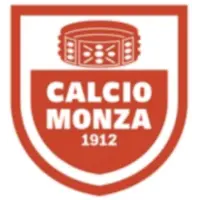
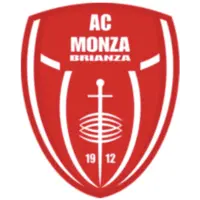
In 2000, the club modernised its visual identity once again. The badge became a rounded-bottom shield with a red crown placed in the upper section on a white background. The lower portion featured the words "Calcio Monza 1912" in white lettering against a red field. Four years later, another redesign introduced a more rounded shield bearing the inscription "AC Monza Brianza." A minimalist depiction of a sword cutting through a crown appeared beneath the text, representing both the Corona Ferrea and the Visconti heritage.
Monza celebrated its centenary during the 2012–13 season with a special commemorative version of the crest. A golden crown decorated with red and white gems was placed above the badge, while the initials "MB" (Monza Brianza) appeared below. The dates 1912 and 2012, together with the number 100, highlighted the club's century of history.
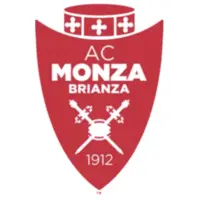
Beginning with the 2013–14 season, Monza introduced a red shield featuring the club name in white capital letters. The Corona Ferrea was positioned above the shield, while two crossed Visconti swords appeared within it. This design reinforced the club's historical roots while presenting a cleaner and more contemporary appearance.
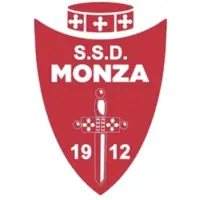
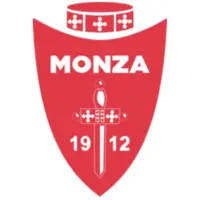
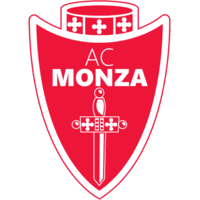
The crest underwent further refinements in 2015, when the crossed swords were replaced by a single vertical sword and the club name changed to "S.S.D. Monza" following an organisational restructuring. Subsequent updates altered the wording to "Monza" in 2016 and "AC Monza" in 2019 as the club continued to evolve.
A final refinement arrived in 2021. A thin red outline was added around the existing shield, enclosing the white border and giving the badge greater visual definition. The same year, Monza published a comprehensive brand manual detailing the badge's geometric construction, typography and official colour palette, including the shade known as Rossa Monza. This move reflected the club's increasingly professional approach to branding during its rise toward Serie A.

AC Monza Club History
AC Monza is one of the oldest football clubs in Lombardy and has long been an important presence within Italian football. Based in the city of Monza, just north of Milan, the club was founded in 1912 as Monza Foot-Ball Club. Although much of its history was spent outside Italy's top division, Monza developed a strong local identity and built a reputation as one of the country's most established provincial clubs before eventually reaching Serie A for the first time in the twenty-first century.
From its foundation, Monza played in blue and white colours. However, in 1932 the club adopted the red-and-white colours that remain associated with the team today. The change proved significant, as the club became widely known as I Biancorossi ("The White and Reds"), a nickname that has endured for generations and remains central to Monza's identity.
Despite its sporting tradition, the club faced considerable financial challenges during the early twenty-first century. Monza experienced severe economic difficulties and was declared bankrupt in 2004. The collapse forced the club to reorganise and rebuild under a new structure. Although Monza recovered and returned to professional football, further financial instability followed in subsequent years.
The situation worsened again in 2015 when the club suffered a second bankruptcy. Once more, Monza was forced to restart and reconstruct its sporting and financial foundations. For a club with more than a century of history, the repeated crises threatened its future and left supporters uncertain about what lay ahead.
A transformative moment arrived in 2018 when former Italian Prime Minister and long-time football executive Silvio Berlusconi acquired the club. Berlusconi, renowned for overseeing one of the most successful periods in the history of AC Milan, purchased Monza alongside trusted associate Adriano Galliani. Their arrival marked the beginning of an ambitious project designed to bring Monza to Serie A for the first time.
Under Berlusconi and Galliani, the club invested heavily in infrastructure, recruitment and professional organisation. The results were immediate. Monza secured promotion from Serie C and rapidly established itself as a contender in Serie B. After several near misses, the club achieved the greatest accomplishment in its history in 2022 by securing promotion to Serie A for the first time ever.
Monza plays its home matches at the Stadio Brianteo, officially known today as the U-Power Stadium. The ground has been the centre of the club's identity for decades and witnessed both the hardships of financial collapse and the celebrations of promotion to Serie A.
The club's most important rivalries are with Como 1907, Pro Sesto and Pisa SC. The rivalry with Como is particularly significant, representing one of Lombardy's most notable provincial football rivalries. Encounters with Pro Sesto carry strong regional importance, while matches against Pisa developed through numerous competitive meetings across the lower divisions.