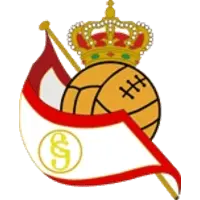
Unlike many clubs that adopted elaborate badges from their inception, Sporting spent its earliest years without any official emblem displayed on its shirts. During the club's formative decades, identity was expressed primarily through its red-and-white colours rather than through a formal crest.
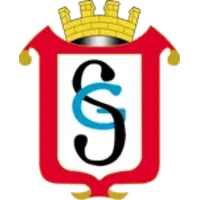
It was not until the 1920s that Sporting introduced its first official badge. This early design took the form of a traditional heraldic shield divided into three sections. The badge was intended to represent both the football club and the city of Gijón, reflecting the growing importance of civic symbolism within Spanish football during the period. The introduction of the crest coincided with the club's increasing prominence and the consolidation of its identity as one of Asturias' leading sporting institutions.
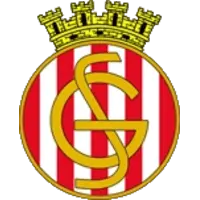
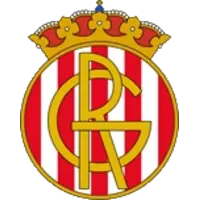
A significant change occurred during the era of the Second Spanish Republic between 1931 and 1936. Following the abolition of the monarchy, royal symbols were removed from many institutions across Spain, including football clubs. Sporting's badge was redesigned with a circular shield, and the royal crown that had previously appeared above the emblem was replaced by a mural crown, a symbol commonly associated with republican civic authority. This transformation reflected the wider political changes taking place throughout the country rather than any alteration in the club's sporting identity.
Following the restoration of royal symbolism in Spanish public life, Sporting gradually returned to a badge incorporating a crown. Over the following decades, the club refined and simplified its visual identity while retaining the elements that had become most closely associated with its history. The red-and-white stripes, already established as the club's defining colours, became increasingly prominent within the crest and helped strengthen Sporting's recognisable image.
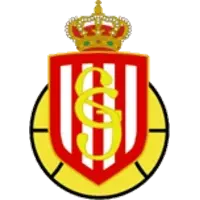
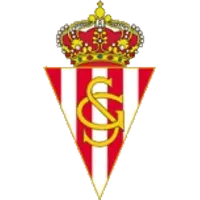
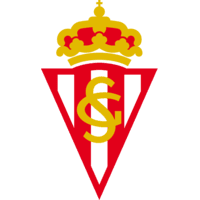
The modern badge emerged through a series of refinements that transformed the earlier heraldic designs into the emblem recognised today. The crest adopted a distinctive triangular shield shape filled with the club's famous red-and-white vertical stripes. Across these stripes are intertwined the gold letters "S" and "G", representing Sporting and Gijón respectively. This monogram became the badge's central feature, creating a simple yet highly distinctive visual identity that could be immediately associated with the club.
Crowning the shield is the royal crown, a reference to the club's title of "Real" and its royal patronage. Sporting received royal recognition during the reign of Alfonso XIII, and the crown has remained an important symbol of the club's heritage ever since. Its presence distinguishes Sporting from many clubs whose badges focus primarily on civic or regional imagery.
Throughout the late twentieth and early twenty-first centuries, Sporting made only minor adjustments to the crest. These updates focused on improving proportions, modernising artwork and enhancing the clarity of the monogram and crown for reproduction across merchandise, digital platforms and broadcast media. Unlike clubs that pursued radical rebranding projects, Sporting consistently preserved the badge's essential structure, ensuring continuity with its historical identity.
Real Sporting de Gijón Club History
Real Sporting de Gijón, S.A.D. has been a central figure in Spanish football since its foundation in 1905. Known affectionately as Los Rojiblancos due to their famous red-and-white striped shirts, Sporting has built a reputation for tradition, resilience and a deep connection to Asturian football culture.
The club's origins can be traced to the early years of the twentieth century when football was beginning to establish itself in northern Spain. Originally founded as Sporting Gijonés, the club quickly became one of the leading football institutions in Asturias. In 1912, Sporting received royal patronage from King Alfonso XIII and was granted the title "Real," becoming Real Sporting de Gijón. This royal recognition reflected the club's growing stature within Spanish football.
A defining feature of Sporting's identity is its home ground, the legendary El Molinón. The stadium is widely recognised as the oldest professional football venue in Spain, with documented football activity dating back to at least 1908.
Throughout the first half of the twentieth century, Sporting established itself as one of the strongest clubs outside Spain's traditional footballing centres. The club became a regular participant in national competitions and was among the founding members of La Liga in 1929. Although major national trophies proved elusive, Sporting consistently competed at a high level and developed a reputation for producing talented players and entertaining football.
One of the club's most remarkable distinctions is its long-term consistency within Spanish football. Real Sporting is one of only nine clubs that have never competed below the second tier of the Spanish league system.
The most successful period in Sporting's history arrived during the 1970s and early 1980s. Under a generation of talented local players and strong management, the club emerged as one of Spain's strongest teams. Sporting finished as runners-up in La Liga during the 1978–79 season, the highest league finish in club history, and regularly qualified for European competitions.
The club also enjoyed memorable runs in domestic cup competitions, most notably reaching the final of the Copa del Rey on multiple occasions. Although Sporting fell short of lifting a major national trophy, these achievements reinforced the club's status as one of Spain's most respected football institutions.
A defining aspect of Sporting's identity is its fierce rivalry with Real Oviedo. Known as the Asturian Derby. The rivalry reflects the historic competition between Gijón and Oviedo, the two principal cities of Asturias, and has been a cornerstone of regional football culture for generations.