Skip to Content

Historical Crests Glasgow Rangers FC

Name: ​Glasgow Rangers FC
Nickname(s): ​The Gers
Founded: 1872
Stadium: Ibrox (Glasgow)
Capacity: 50,817

1904-1959
1959-1968
1968-1990
1990-1994
1994-1997
1997-2003
2003-Present

Glasgow Rangers Crest History
Rangers Football Club possesses one of the most distinctive visual identities in world football. Unlike most clubs, Rangers are unique in using two official logos simultaneously: a corporate crest used for branding, media and merchandise, and a separate primary crest worn on the players’ shirts. Together, these emblems reflect more than 150 years of history, tradition and Scottish heritage.
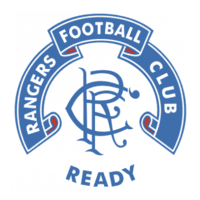
The earliest Rangers badges were based around the club’s famous monogram. Intertwined letters spelling “RFC” (Rangers Football Club) became closely associated with the club and appeared on shirts, official documents and club publications throughout much of Rangers’ history. The monogram was often accompanied by a ribbon bearing the club’s motto, “Ready,” a phrase that remains central to the club’s identity today.
For many supporters, the RFC scroll crest remains one of the most iconic symbols in Scottish football. Although the design underwent minor refinements over the decades, the fundamental monogram remained largely unchanged and became synonymous with Rangers’ domestic and European successes.
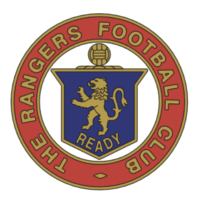
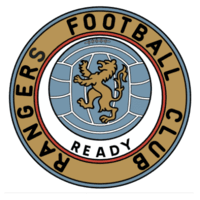
A major development came in 1968 when Rangers introduced a new corporate-style emblem featuring a red rampant lion positioned above a blue football. The rampant lion, one of Scotland’s most important heraldic symbols, reflected both national pride and the club’s ambitions. The addition of the football created a more modern sporting identity while retaining strong links to Scottish tradition.
Over the following decades, the lion crest became increasingly prominent in the club’s branding and commercial activities. While the RFC scroll continued to appear on playing kits, the lion emblem was used extensively across official club materials, merchandise and marketing.
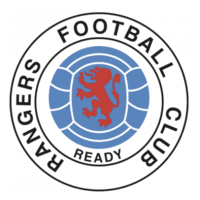
In 1997, the lion badge underwent a significant redesign. The updated crest featured a sleeker and more dynamic lion, lighter blue colouring, cleaner lines and stronger typography. The modernised appearance reflected contemporary branding trends while preserving the traditional elements that supporters recognised. This version became the basis of the corporate logo still associated with Rangers today.
As a result, Rangers developed a unique dual-badge system:
Primary Logo (Kit Crest)
The crest worn on Rangers shirts remains the famous RFC scroll monogram. Rooted in the club’s earliest history, the intertwined letters represent continuity, tradition and the club’s long-standing identity. The design has undergone subtle refinements over the years but remains fundamentally unchanged and instantly recognisable to supporters around the world.
Corporate Logo
Used for official communications, merchandise and commercial branding, this crest features the red rampant lion above a blue football, surrounded by the club’s name and the motto “Ready.” It serves as the club’s primary corporate identity and is a modern evolution of the lion badge first introduced in 1968.
The dual-logo approach allows Rangers to celebrate both tradition and modernity. The RFC scroll maintains a direct connection to the club’s historic roots, while the lion crest provides a powerful and versatile symbol for contemporary branding.


Glasgow Rangers Club History
Rangers Football Club was founded in 1872 by four friends, Moses McNeil, Peter McNeil, Peter Campbell and William McBeath, who shared a passion for the emerging game of association football. What began as a local team in Glasgow would grow into one of the most successful and recognisable football clubs in the world.
From its earliest years, Rangers established itself as a major force in Scottish football. The club became a founding member of the Scottish Football League in 1890 and quickly developed a reputation for success, winning league titles and cup competitions on a regular basis. Over time, Rangers would become one of the most decorated clubs in world football.
The club's home is Ibrox Stadium, which has served as Rangers’ home ground since 1899. One of the most famous stadiums in football, Ibrox has witnessed countless historic matches and remains a symbol of the club’s proud traditions and passionate support.
Historically, Rangers drew much of its support from Glasgow’s shipbuilding communities and the city’s Protestant population. These social and cultural roots played an important role in shaping the club’s identity and contributed to the development of one of football’s most famous rivalries.
The club’s greatest rivalry is with Celtic. Matches between the two sides are known as the “Old Firm” derby and are among the most celebrated and intense fixtures in world football. Rooted in sporting competition as well as historical, cultural and religious differences within Glasgow, the rivalry has produced more than 400 meetings and remains one of football’s defining contests.
Despite the intensity of the rivalry, there have also been moments of unity. Following the tragic Ibrox disaster of 1971, which claimed the lives of 66 supporters, football communities across Scotland came together in support of those affected. The disaster remains one of the most significant and emotional events in Rangers’ history, and its legacy continues to be remembered by the club and its supporters.
Throughout the twentieth century, Rangers enjoyed extraordinary success. The club won numerous Scottish League Championships, Scottish Cups and League Cups, while also becoming a regular participant in European competition. One of the club’s greatest achievements came in 1972 when Rangers won the European Cup Winners’ Cup, defeating Dynamo Moscow in the final to claim their first major European trophy.
In the modern era, Rangers continued to dominate Scottish football and achieved a historic milestone by becoming the first club in the world to win 50 national league titles. However, one of the most dramatic chapters in the club’s history arrived in 2012.
Following severe financial difficulties, Rangers entered administration and subsequently faced liquidation of the original company operating the club. The club was required to restart in the fourth tier of Scottish football. What could have marked the end of Rangers instead became one of the greatest demonstrations of supporter loyalty ever witnessed in football. During the club’s first season in the bottom division, a world-record crowd of 49,118 attended a league match, illustrating the unwavering dedication of the Rangers support.
The years that followed saw Rangers achieve successive promotions and rebuild its position within Scottish football. By 2016, the club had returned to the Scottish Premiership, completing one of the most remarkable recoveries in modern football.
A further landmark arrived in 2020–21 when Rangers won the Scottish Premiership title under manager Steven Gerrard, securing the club’s 55th league championship and ending Celtic’s run of nine consecutive titles. The achievement reinforced Rangers’ status as one of football’s most resilient institutions.

Our latest content

Your Dynamic Snippet will be displayed here... This message is displayed because you did not provide enough options to retrieve its content.