Skip to Content

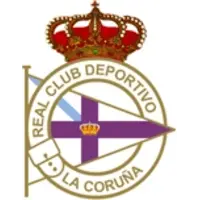
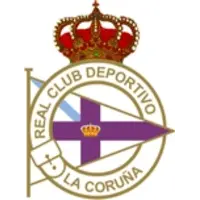
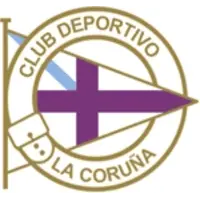
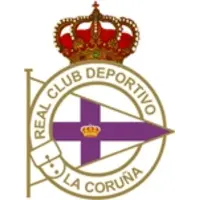
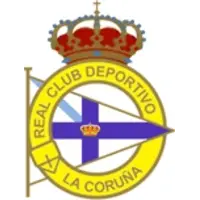
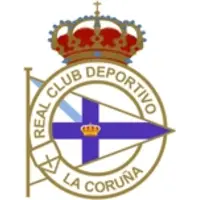
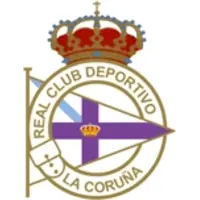
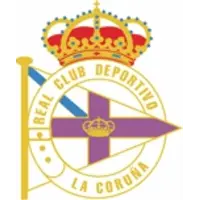
Historical Crests Deportivo La Coruña

Name: ​Deportivo La Coruña
Nickname(s): Os Brancoazuis (The Blue and Whites), Herculinos (The Herculans), Turcos (The Turks) 
Founded: 1906
Stadium: Riazor (A Coruña)
Capacity: 32,490

1906-1908
1908-1910
1910-1911
1911-1912
1912-1928
1928-1931
1931-1941
1941-1955
1955-1962
1962-1973
1973-1997
1997-2000
2000-Present

Deportivo La Coruña Crest History
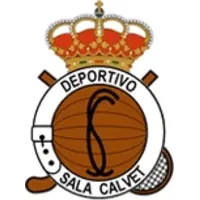
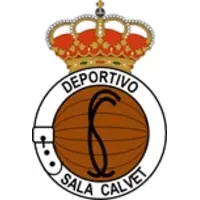
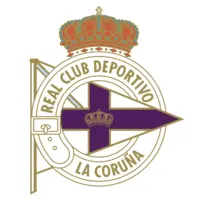
The origins of the crest of Deportivo La Coruña can be traced to the club’s predecessor, Sala Calvet, a gymnasium where many of Deportivo’s founders first gathered to play football. As a tribute to these beginnings, the club adopted a badge featuring a gentleman’s belt encircling the gymnasium’s banner. This unique design has remained one of the defining elements of Deportivo’s visual identity for more than a century.
A significant addition came in 1910, when King Alfonso XIII granted the club royal patronage. As a result, Deportivo was permitted to adopt the honorary title “Real” and add a royal crown to its crest. The crown became a prominent feature of the badge and symbolised the club’s official recognition by the Spanish monarchy.
In 1912 there was a significant change. At the centre of a new crest there was a purple-and-white banner crossed by a diagonal sky-blue stripe. The banner proudly displays a sky-blue band representing the maritime flag of A Coruña, which is also closely associated with the flag of Galicia. This element reinforces the club’s deep connection to both its city and regional heritage, making the crest one of the most recognisable symbols in Galician sport.
Like many Spanish clubs that enjoyed royal patronage, Deportivo’s crest was affected by political changes during the twentieth century. During the period of the Second Spanish Republic, both the honorary “Real” title and the royal crown were removed from the club’s identity in accordance with republican policies. However, following the Spanish Civil War and during the era of Francoist Spain, both the royal designation and the crown were restored to the crest.
Throughout the twentieth century, Deportivo’s badge underwent only modest refinements. Unlike many clubs that repeatedly redesigned their visual identity, Deportivo largely preserved the historic composition of the belt, banner, diagonal stripe and crown. Changes were generally limited to modernising proportions, improving clarity and adapting the design for contemporary use while maintaining its traditional appearance.
The club’s most recent updates have focused on digital optimisation and graphic consistency rather than radical redesign. As a result, the modern crest remains remarkably faithful to the emblem that supporters have recognised for generations.


Deportivo La Coruña Club History
Founded in 1906, Deportivo de La Coruña is one of the most historic football clubs in Galicia and one of the most recognisable names in Spanish football. Based in the city of A Coruña, the club has long served as a symbol of Galician football and regional identity.
The club was established by local sports enthusiasts led by Luis Cornide and initially played friendly matches before entering organised competitions. In 1909, King Alfonso XIII granted the club royal patronage, allowing it to adopt the title Real Club Deportivo de La Coruña, a distinction it retains today.
During the early decades of Spanish football, Deportivo established itself as one of Galicia’s leading clubs. The opening of the Estadio de Riazor in 1944 provided the club with a permanent home and helped support its growing ambitions.
Real Club Deportivo de La Coruña, based in the city of A Coruña, Galicia, Spain, has a notable history in football. Their debut in the first division occurred in 1949, marking the beginning of the club’s long relationship with Spanish football’s top tier. Although Deportivo experienced periods of promotion and relegation during the following decades, they remained a respected presence within the national game.
The club’s golden era began in the early 1990s under the presidency of Augusto César Lendoiro. After years outside the spotlight, Deportivo emerged as one of Spain’s strongest teams and became known as “Super Dépor.” A remarkable breakthrough came in 1993, when the club finished as runners-up in La Liga and announced itself as a genuine challenger to the traditional dominance of Spain’s biggest clubs.
During this period, Deportivo assembled an outstanding squad featuring stars such as Bebeto, Mauro Silva, Fran González and later Roy Makaay. With these players, Deportivo consistently challenged both Real Madrid CF and FC Barcelona, competing for domestic honours at a time when few clubs could rival the traditional powers.
The greatest achievement in the club’s history arrived in 2000, when Deportivo won its first and only La Liga title. The triumph remains one of the most celebrated accomplishments in Spanish football history, as the club from Galicia succeeded in breaking the dominance of the country's traditional giants and securing the national championship.
Success continued into the new century. Deportivo won domestic cup competitions and established itself as a regular participant in European tournaments. The pinnacle of its continental achievements came during the 2003–04 UEFA Champions League, when the club reached the semi-finals. Along the way, Deportivo produced one of the competition’s most memorable comebacks, overturning a 4–1 first-leg deficit against AC Milan with a stunning 4–0 victory at Riazor.
A defining feature of Deportivo’s identity is its rivalry with RC Celta de Vigo. Matches between the two clubs are known as the Galician derby (Derbi Galego) and represent one of Spain’s most passionate regional rivalries. The fixture carries enormous significance throughout Galicia, with supporters from A Coruña and Vigo fiercely contesting regional supremacy.
However, the years following the club’s golden era proved increasingly difficult. Since 2015, Deportivo has experienced a prolonged period of decline, suffering relegations and financial challenges that have taken the club away from the upper reaches of Spanish football

RD Deportivo La Coruna Pins

Your Dynamic Snippet will be displayed here... This message is displayed because you did not provide enough options to retrieve its content.