Few cities provide a football setting quite like Edinburgh. The castle, the closes of the Old Town and the elegant streets of the New Town attract visitors from across the world, but on derby day the Scottish capital reveals a very different side of its character. Maroon scarves head west towards Gorgie, green-and-white colours gather around Leith, and one question matters more than any other: Hearts or Hibs?
The Edinburgh derby between Heart of Midlothian and Hibernian is one of the oldest and most frequently played city rivalries in world football. Its story began on Christmas Day 1875 and has since produced cup finals, record crowds, extraordinary comebacks, humiliating defeats and even a match that thousands followed on the radio despite the commentator being unable to see the pitch.
This is more than a fixture between two Scottish football clubs. It is 150 years of Edinburgh history in maroon and green.
Two Clubs Born in the Same City
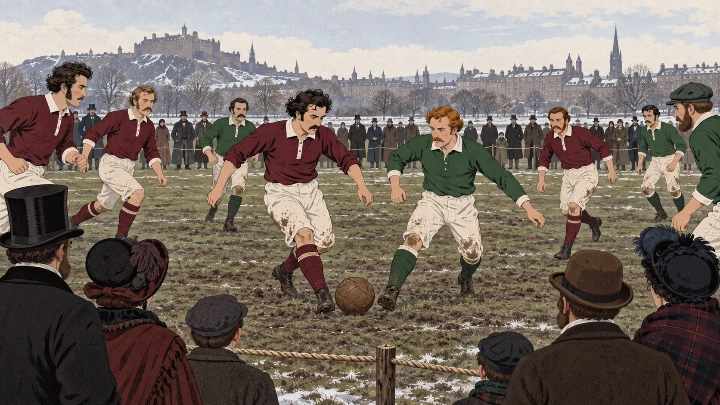
Heart of Midlothian was formed in 1874. The club grew out of the Heart of Mid-Lothian Quadrille Assembly, a social and dancing club whose members began playing football on the Meadows. The name itself has deep Edinburgh roots. It refers to the Old Tolbooth, the former prison and administrative building beside St Giles’ Cathedral that became known as the Heart of Midlothian and was immortalised in Sir Walter Scott’s novel of the same name.
Hibernian was founded a year later by members of Edinburgh’s Irish community in the Cowgate, an area once nicknamed Little Ireland. The club emerged from the Catholic Young Men’s Society connected to St Patrick’s Church. Its name came from Hibernia, the Roman name for Ireland, while green shirts, the harp and the motto Erin Go Bragh, Ireland Forever, expressed those origins.
Hibs initially met resistance from the Scottish football establishment. Their applications to join the Edinburgh Football Association and the Scottish FA were rejected, and other clubs were discouraged from playing them. Hearts eventually accepted the challenge, however, and the two teams met on the East Meadows on Christmas Day 1875.
Hearts won 1–0. A rivalry had been born.
In January 2026, representatives of both clubs unveiled a bronze plaque beside the Meadows to mark the exact area in which the first recorded Edinburgh derby was played. A century and a half after that modest Christmas fixture, Hearts vs Hibs remains one of the central events in the city’s sporting calendar.
How Hearts and Hibs Took Control of Edinburgh
The early rivalry was not built around league football because the Scottish Football League did not yet exist. Hearts and Hibs instead faced each other in friendlies, charity matches and local cup competitions.
One Edinburgh FA Cup tie in 1878 required five matches to decide. The first four ended level before Hearts finally won the fourth replay 3–2. Meetings such as these helped the two young clubs establish themselves as Edinburgh’s leading sides.
The first league derby was played at Tynecastle in September 1895, with Hearts winning a seven-goal thriller 4–3. By then the rivalry was no longer merely local entertainment. Both clubs had become important forces in Scottish football.
Historical totals vary because so many early friendlies and local competitions can be included or excluded. Counting only League, Scottish Cup and League Cup matches, the clubs had met 360 times by September 2026. Hearts held the advantage with 157 victories, compared with 98 for Hibs and 105 draws. When old local tournaments, wartime fixtures and friendlies are added, the number of recorded meetings rises far beyond 600.
1896: A Scottish Cup Final in Edinburgh
The rivalry reached a national stage on 14 March 1896 when Hearts and Hibs contested the Scottish Cup Final. The match was played at New Logie Green, then the home of St Bernard’s, rather than at either club’s own stadium.
It remains the only Scottish Cup Final ever staged outside Glasgow.
An attendance of 16,034 watched Hearts win 3–1 through goals from Davie Baird, Alex King and Willie Michael. Jo O’Neill scored for Hibs, but the trophy went back to Gorgie. It would be 116 years before the Edinburgh rivals met in another Scottish Cup Final.
The Fog Derby Nobody Could See
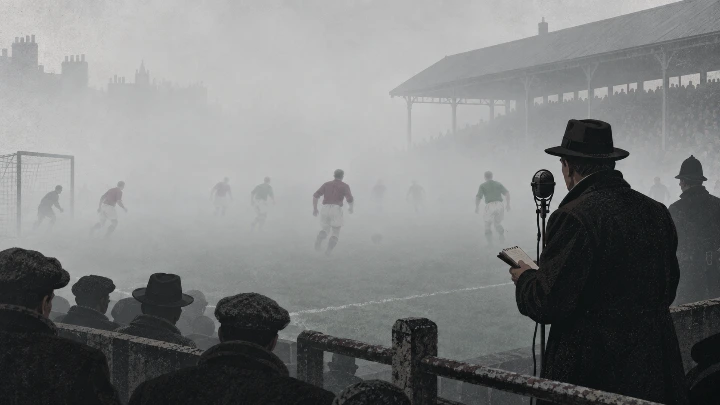
One of the strangest stories in British football took place at Easter Road on New Year’s Day 1940. Scotland was several months into the Second World War, and Edinburgh was covered by fog so thick that much of the pitch could barely be seen from the stands.
The match still went ahead and Hearts won an extraordinary game 6–5. Yet the score is only part of the story.
According to the famous account of the afternoon, BBC radio commentator Bob Kingsley could see little more than a few yards of the field. Wartime restrictions meant he was not supposed to describe the weather conditions, as such information might have been useful to enemy aircraft. With runners attempting to bring him updates and the noise of the crowd providing occasional clues, Kingsley had to fill long passages of the broadcast with imagined tackles, shots and dribbles.
The tale has acquired some embellishments over the decades, but it remains perfect Edinburgh derby folklore: eleven goals, almost no visibility and a commentator trying to create a match for listeners that he could scarcely see himself.
A Record Crowd at Easter Road
Edinburgh football entered a golden period after the war. Hibs won three league championships between 1948 and 1952 with their celebrated Famous Five forward line, while Hearts built a trophy-winning side that dominated much of the late 1950s and early 1960s.
On 2 January 1950, no fewer than 65,860 spectators packed into Easter Road for the derby. Hearts won 2–1. The attendance remains the record for an Edinburgh derby and for a football match played in Scotland outside Glasgow.
Modern all-seater stadiums mean that figure will never be approached again, but it shows how powerful football in the capital had become.
0–7: Hibernian’s Greatest Derby Day
Ask a Hibs supporter for the most beautiful scoreline in the club’s history and there is a good chance the answer will be 0–7.
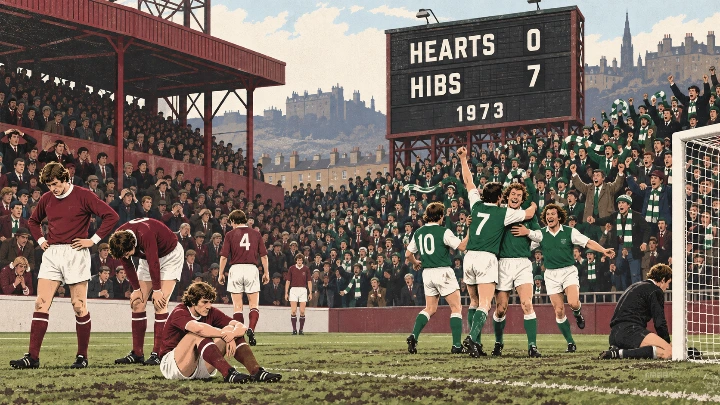
On New Year’s Day 1973, Eddie Turnbull’s outstanding Hibernian side travelled across the city to Tynecastle. Known as Turnbull’s Tornadoes, Hibs played fast, attacking football and arrived as one of Scotland’s most entertaining teams.
They were 5–0 ahead by half-time.
Two more goals followed after the break as Jimmy O’Rourke, Alan Gordon, Arthur Duncan and Alex Cropley completed a historic 7–0 victory. It remains the largest winning margin in a competitive Edinburgh derby. The fact that it happened at Tynecastle made it even sweeter for the travelling support.
For Hearts fans, 1 January 1973 is a date best avoided. For Hibs, “seven-nil” became part of the club’s identity, celebrated in songs, flags and conversations passed from one generation to the next.
The Eight-Goal Derby of 2003
Less than five months after De Vries’ four-goal performance, Tynecastle witnessed another classic.
On 2 January 2003, Hearts and Hibs produced a chaotic 4–4 draw. The match already contained six goals when Hibs scored late to move 4–2 ahead. With the away supporters celebrating what appeared to be a famous victory, young Hearts substitute Graham Weir transformed the ending.
Weir scored twice in the closing seconds of stoppage time, with his two goals reportedly separated by only 42 seconds. Hearts had rescued a draw from an apparently hopeless position; Hibs had somehow allowed victory to disappear.
It was not a win for either side, but it remains one of the most dramatic matches in the history of the Edinburgh derby.
2012: The “Mother of All Edinburgh Derbies”
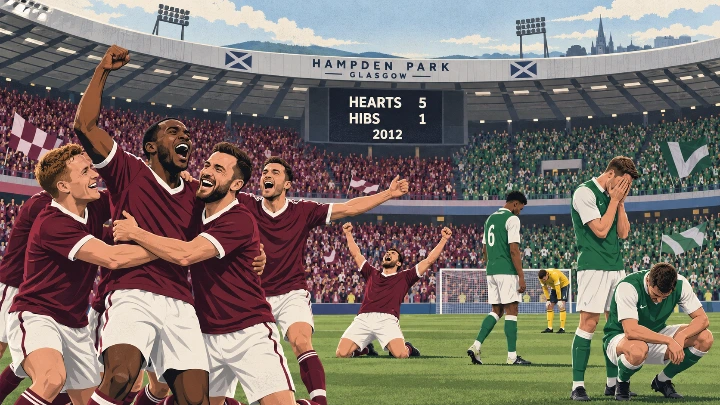
For the first time since 1896, Hearts and Hibernian met in the Scottish Cup Final on 19 May 2012. More than 50,000 supporters travelled west from Edinburgh to Hampden Park for a match promoted as the “Salt and Sauce Final” and widely described as the Mother of All Edinburgh Derbies.
The stakes were enormous. Victory would bring a major trophy, but defeat would live forever in the songs and banners of the other half of the city.
Hearts took control through goals from Darren Barr and Rudi Skácel. James McPake pulled one back for Hibs before half-time, but the contest changed decisively after the break. Danny Grainger converted a penalty, Hibs were reduced to ten men, and further goals from Ryan McGowan and Skácel completed a crushing 5–1 Hearts victory.
For the Jambos, it was one of the greatest days in club history. For Hibs, it was the nightmare result in the match they could least afford to lose. More than a decade later, “five-one” remains one of the first phrases heard whenever the two sets of supporters begin comparing derby memories.
2016: The Derby That Changed Hibernian’s History
Hibs found a powerful answer four years later.
In the fifth round of the 2015–16 Scottish Cup, Hearts led 2–0 at Tynecastle with only ten minutes remaining. Jason Cummings gave Hibs hope before Paul Hanlon scored a stoppage-time equaliser to force a replay at Easter Road.
Cummings scored again in the replay as Hibernian won 1–0. That victory did far more than eliminate Hearts: it kept alive a cup run that would finally end 114 years of frustration.
Hibs reached the final against Rangers and won 3–2 when captain David Gray headed in a stoppage-time winner. As Sunshine on Leith echoed around Hampden, Hibernian lifted the Scottish Cup for the first time since 1902. The comeback at Tynecastle had been the moment when that historic journey nearly ended — and the moment it truly came alive.
Tynecastle Park vs Easter Road
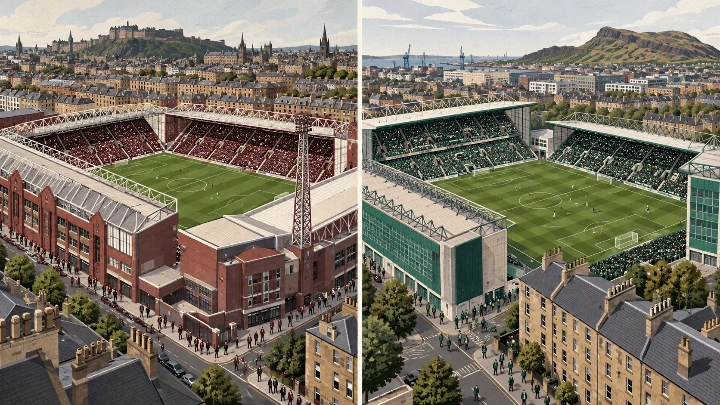
The Edinburgh derby is enhanced by two grounds with very different personalities.
Tynecastle Park, situated in the working-class district of Gorgie, holds just under 20,000 spectators. Its steep stands sit close to the pitch, trapping the noise and creating one of the most intense atmospheres in Scottish football. On derby day, the sea of maroon makes the stadium feel even tighter.
Easter Road, the home of Hibernian in Leith, accommodates around 20,400 supporters. Its four separate stands create a more open appearance, while the large East Stand and the view towards Arthur’s Seat give the ground a distinctly Edinburgh setting. After major Hibs victories, few scenes in British football are more atmospheric than the home support singing Sunshine on Leith.
Only around four miles separate the two stadiums, but on derby day they can feel like different worlds.
Visiting the Edinburgh Derby
For groundhoppers, Hearts vs Hibs is one of the most attractive fixtures in British football — and one of the hardest tickets to obtain.
Derby matches regularly sell out, and away tickets are normally distributed through the visiting club using loyalty points or a purchasing-history system. Tickets should therefore be arranged well in advance through the official Hearts or Hibernian ticket channels. Do not travel to Tynecastle or Easter Road expecting to buy a derby ticket at the turnstiles.
Even without a ticket, both parts of the city are worth exploring. Gorgie offers traditional football surroundings, the Hearts Museum and the walk from Haymarket towards Tynecastle. Leith provides historic streets, pubs, restaurants and the route along Easter Road towards Hibs’ home.
For the complete Edinburgh football experience, visit both stadiums. They tell two different stories about the same city.
More Than Maroon Against Green
The Edinburgh derby does not need the global profile of the Old Firm to feel important. Its power comes from proximity. Hearts and Hibs supporters live in the same streets, work in the same offices and often belong to the same families. There is no escape from the result on Monday morning.
The rivalry has survived changing stadiums, two world wars, relegations and more than six hundred meetings of every description. It has delivered seven-goal humiliations, last-second comebacks, Dutch cult heroes and two Scottish Cup finals separated by 116 years.
From the East Meadows in 1875 to modern Tynecastle and Easter Road, the setting has changed beyond recognition. The question has not. Hearts or Hibs?