Few matches carry as much history, pride and emotion as England against Scotland. It may no longer be played every year, but whenever the Three Lions meet the Tartan Army, more than 150 years of football rivalry return to the pitch. This is not simply another international fixture, it is the oldest rivalry in international football.
Where International Football Began
On 30 November 1872, Scotland and England met at Hamilton Crescent, a cricket ground in Partick, Glasgow. Between 2,500 and 4,000 spectators paid one shilling to witness what is officially recognised as the first international football match in history.
Scotland’s team was made up entirely of players from Queen’s Park, then the country’s leading club. England arrived with players representing several different teams. The match ended 0–0, but its importance went far beyond the result: international football had been born.
The fixture quickly became an annual tradition. With England and Scotland developing different footballing identities, their meetings offered an early clash of styles. England generally favoured individual dribbling and physical strength, while Scotland became known for its short passing and combination play.
The Auld Enemy
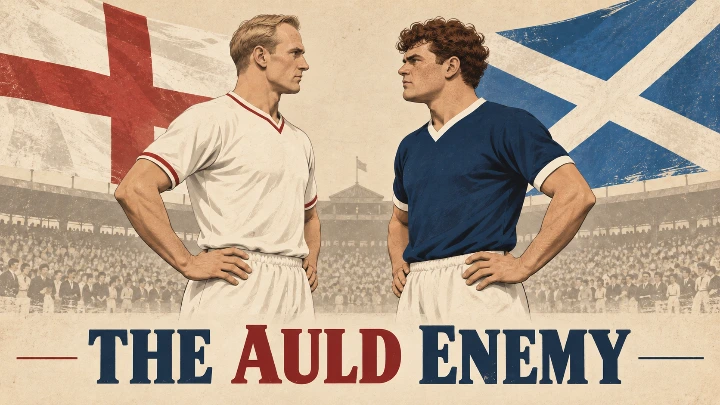
For Scotland, England became known as the “Auld Enemy”. The nickname reflects centuries of historical and political rivalry between the two countries, but on the football pitch it developed a meaning of its own.
Beating England became one of the greatest achievements available to a Scottish footballer. For England, losing to their northern neighbours was equally difficult to accept, particularly during the early decades, when Scotland regularly held the upper hand.
Between 1884 and 1984, the fixture formed the centrepiece of the British Home Championship, the annual tournament contested by England, Scotland, Wales and Ireland, later Northern Ireland. Before the creation of the World Cup and European Championship, winning this competition was one of international football’s highest honours.
Except for interruptions caused by the two World Wars, England and Scotland faced each other almost every year. For generations of supporters, the match was one of the most important dates on the football calendar.
The Wembley Wizards of 1928
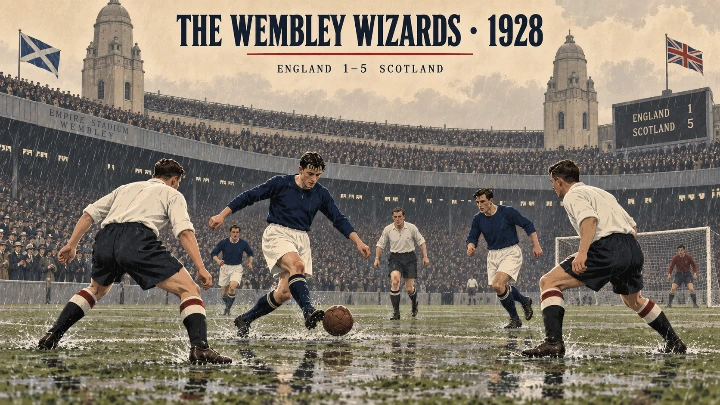
One of Scotland’s greatest victories came at Wembley on 31 March 1928. England were expected to dominate, but the visitors produced a remarkable display of passing football and won 5–1.
The Scottish team became immortalised as the “Wembley Wizards”. Alex Jackson scored a hat-trick, while Alex James produced a masterful performance in midfield. The victory remains one of the most celebrated results in Scottish football history.
A Record Crowd at Hampden Park
From 9–3 to the Unofficial World Champions
The rivalry has produced dramatic changes in fortune. In 1961, England recorded the biggest victory in the fixture’s history by beating Scotland 9–3 at Wembley.
Six years later, Scotland returned to the same stadium and defeated the reigning world champions 3–2. England had won the World Cup at Wembley in 1966, so the Scottish supporters jokingly proclaimed their team the new “unofficial world champions.”
Jim Baxter became the symbol of the victory. With Scotland in control, he famously slowed the match down and played with the English defence, even performing keepie-uppies while waiting for teammates to move into position.
Wembley 1977: Scotland Takes Over
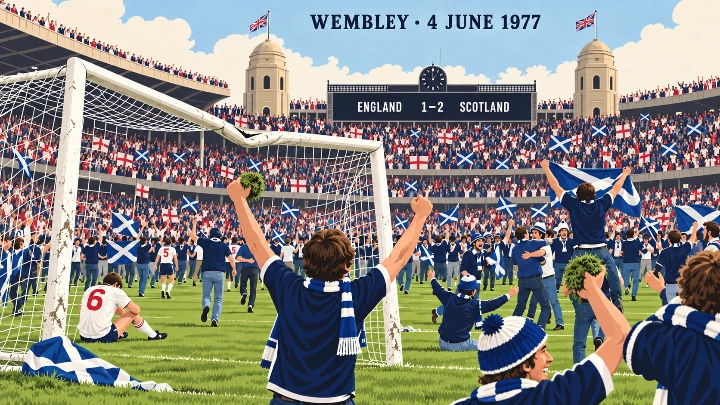
The most chaotic chapter in the rivalry occurred on 4 June 1977. Almost 100,000 people filled the old Wembley Stadium, with Scottish supporters making up an estimated two-thirds of the crowd.
Both countries were competing for the British Home Championship and pursuing qualification for the 1978 World Cup in Argentina. Scotland also arrived carrying the painful memory of a 5–1 defeat at Wembley in 1975. This time, however, the Tartan Army would have its revenge.
Gordon McQueen headed Scotland into the lead before Kenny Dalglish made it 2–0. Mick Channon converted a late penalty for England, but Scotland held on for a famous 2–1 victory and claimed the British title.
After the final whistle, thousands of Scottish supporters poured onto the Wembley pitch. Some pulled pieces of turf from the ground as souvenirs. Others climbed onto the goals until one of the crossbars snapped beneath their weight. Parts of the goal and sections of the famous Wembley grass were carried back to Scotland.
According to the stories, supporters even tried to take a broken section of the goal onto the London Underground. Pieces of Wembley turf were later said to have been planted in Scottish gardens.
Singer and passionate Scotland supporter Rod Stewart was among those celebrating on the pitch. Photographs show him being carried above the crowd during the festivities.
Gordon Strachan’s Unexpected Pitch Invasion
Another young Scottish supporter inside Wembley that day was Gordon Strachan. The 20-year-old Dundee midfielder was visiting London while on his honeymoon and decided to attend the match.
Strachan later recalled standing near the edge of the pitch after the final whistle. While many supporters ran onto the field, he initially remained in the stand with his wife and best man. According to Strachan, a police officer saw him hesitating and encouraged him to join the celebrations.
He followed the advice and ran onto the Wembley pitch.
At that moment, few could have predicted that Strachan would become one of Scotland’s finest players, earn 50 international caps and eventually manage the national team. A piece of the old Wembley turf reportedly remained in a garden near Dundee for many years afterwards.
The scenes were celebratory, but the extensive damage also strengthened the growing association between international football and hooliganism during the 1970s.
The End of an Annual Tradition
The British Home Championship continued until 1984, when fixture congestion, falling attendances and concerns surrounding supporter disorder led to its cancellation.
England and Scotland continued meeting in the short-lived Rous Cup until 1989, but the annual tradition was over. From then on, encounters became less frequent, and perhaps even more eagerly anticipated.
The countries were drawn together at Euro 96, producing another iconic Wembley moment. England goalkeeper David Seaman saved Gary McAllister’s penalty before Paul Gascoigne flicked the ball over Colin Hendry and volleyed home one of England’s most celebrated goals.
At Euro 2020, played in 2021, the teams met at Wembley once again. On a rain-soaked evening, Scotland produced a determined performance and held England to a 0–0 draw.
A Rivalry That Still Matters
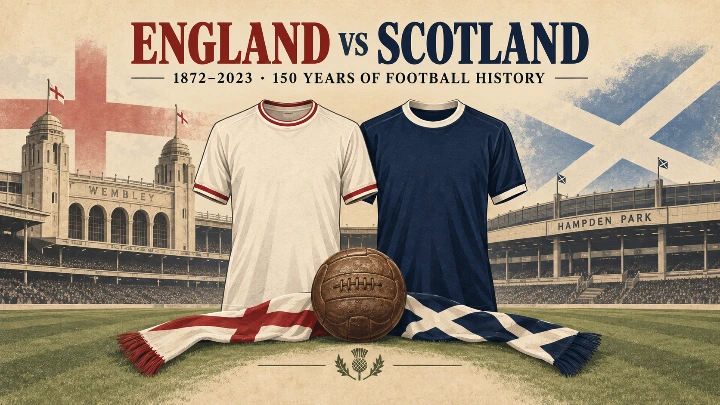
In September 2023, the teams returned to Hampden Park for a special match celebrating the 150th anniversary of their historic first encounter. England won 3–1, but the occasion demonstrated that the rivalry had lost none of its significance.
The fixture has witnessed record crowds, legendary victories, humiliating defeats, broken crossbars and celebrations that became part of football folklore. Its importance cannot be measured by statistics alone.
When England and Scotland meet, they do not simply play another international match. They continue the story that began at a Glasgow cricket ground in 1872, the day international football took its first steps.
Highlights
- First match: Scotland 0–0 England, 30 November 1872
- Location: Hamilton Crescent, Glasgow
- Status: Oldest official international football fixture
- Largest England victory: England 9–3 Scotland, 1961
- Largest Scotland victory: Scotland 7–2 England, 1878
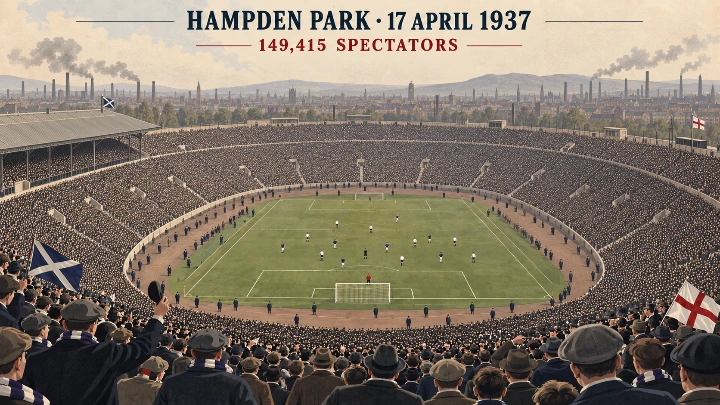
- Record attendance: 149,415 at Hampden Park in 1937
- Most famous celebration: Scotland’s Wembley pitch invasion in 1977