A historic ground, a world-record score and one of Scotland’s most distinctive football clubs
There are football grounds that impress because of their size. Others because of their architecture, atmosphere or history.
And then there is Gayfield Park.
Home of Arbroath FC, Gayfield stands on the eastern edge of the Scottish town of Arbroath, only metres from the North Sea. On a calm summer afternoon, the location can look almost idyllic. Visit during a Scottish winter, however, and the wind coming directly off the sea quickly reminds you that this is no ordinary football ground.
Arbroath may never have become one of Scotland’s footballing giants, but few clubs of its size can offer such a remarkable combination of football history, local identity and an unforgettable stadium.
For many Scottish football supporters, a trip to Arbroath has become one of their favourite away days. Much of its appeal comes from the setting: the train journey along Scotland’s east coast, the walk through the town and harbour, and the first sight of Gayfield Park standing almost directly beside the North Sea.
Add the traditional terraces, friendly matchday atmosphere and the possibility of the wind carrying a wayward football towards the beach, and an away game at Arbroath feels different from almost anywhere else in Scottish football.
And then, of course, there is 36–0.
From the Red Lichties to Arbroath FC
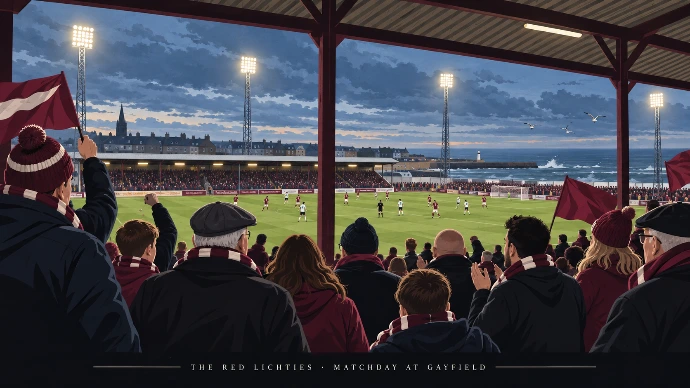
Arbroath Football Club was founded in 1878 and has spent much of its history moving through the different levels of the Scottish league system.
The club is known as The Red Lichties, a nickname connected not directly with football but with Arbroath’s maritime past. The name refers to the red light that was used to guide vessels towards the harbour and is closely associated with the town’s long relationship with the sea.
That relationship is impossible to ignore when visiting Arbroath.
The harbour, fishing industry, Bell Rock Lighthouse and famous Arbroath Smokie are all part of the same local identity that surrounds the football club.
Arbroath is also one of Scotland’s most historically significant towns. The ruins of Arbroath Abbey dominate part of the town and are associated with the famous Declaration of Arbroath of 1320, one of the most important documents in Scottish history.
Football arrived centuries later, but today Arbroath FC is every bit as much a part of the town’s identity.
Gayfield Park – Football Beside the North Sea
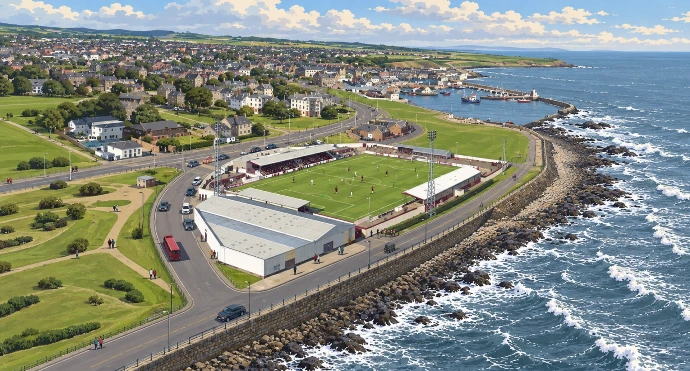
For groundhoppers, the main attraction is Gayfield Park.
The stadium occupies an extraordinary location beside the North Sea. There is little separating parts of the ground from the coastline, meaning the weather can become part of the match itself. Wind, rain and cold are not unusual visitors.
That has helped create Gayfield’s reputation as one of the most atmospheric traditional grounds in Scottish football.
Instead of enormous modern stands and corporate surroundings, Gayfield offers something that is becoming increasingly difficult to find: spectators standing close to the pitch, covered terracing, traditional floodlight pylons and a football ground that feels completely connected to the town around it.
Arbroath have continued to modernise Gayfield over the years while retaining its traditional character. Improvements have included new entrances, club facilities and hospitality areas.
But Gayfield still feels unmistakably like Gayfield. And that is exactly the point.
12 September 1885 – The Day Arbroath Scored 36
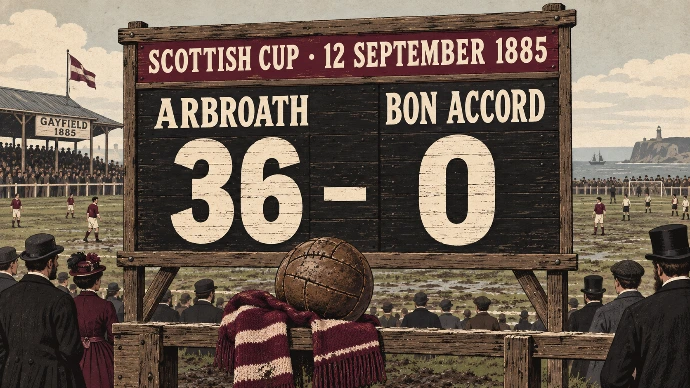
If one match defines Arbroath’s place in football history, it took place on 12 September 1885. Arbroath faced Aberdeen side Bon Accord at Gayfield in the first round of the Scottish Cup. The final score was: Arbroath 36–0 Bon Accord. Arbroath were already 15–0 ahead at half-time. They added another 21 goals after the break.
Even more remarkably, 18-year-old John Petrie scored 13 goals himself—a feat that remains one of the most extraordinary individual performances in the history of British football. Petrie remained closely associated with Arbroath and was eventually inducted into the club’s Hall of Fame. The story becomes even more remarkable when you discover what was happening only a short distance away.
36–0 Wasn’t the only incredible score that Day. On exactly the same afternoon, approximately 18 miles away, Dundee Harp defeated Aberdeen Rovers 35–0. For a brief moment, Dundee Harp believed they had produced a record-breaking result. They hadn’t. News arrived from Arbroath: 36–0. Arbroath had beaten Dundee Harp’s remarkable score by a single goal.
There is even another twist. The referee at the Dundee Harp match reportedly believed that the team had actually scored 37 goals, but club officials had counted only 35. The referee accepted their total, and 35–0 became the official result.
Meanwhile, Arbroath might themselves have scored considerably more. Years later, referee Dave Stormont recalled having disallowed seven Arbroath goals, suggesting that the final score could conceivably have reached 43–0.
Separating Fact from Football Folklore
A match as extraordinary as 36–0 inevitably produces legends. Perhaps the best-known story claims that Bon Accord were actually a cricket team from Aberdeen who had somehow received the Scottish Cup invitation intended for another club. It is a wonderful story. Unfortunately, it almost certainly isn’t true.
Research by Arbroath historian Fraser Clyne challenged the tale and established that Bon Accord really were a football club. The cricket-team story appears to have been added to the legend much later. Another famous story concerns Arbroath goalkeeper Jim Milne. With virtually nothing to do while his teammates attacked continuously at the opposite end, the story goes that Milne borrowed an umbrella from someone in the crowd to shelter from the rain. Unlike the cricket-team story, this account forms part of Arbroath’s own history of the match. Imagine being a goalkeeper in a competitive Scottish Cup match and watching your team score 36 times at the other end.
More Than One Extraordinary Afternoon
It would be unfair to reduce almost 150 years of Arbroath FC history to a single result. The club has experienced promotions, relegations and several memorable periods.
In 2017, Arbroath won the Scottish League Two title. Two years later, another championship followed as the club won Scottish League One in 2018–19, earning promotion to the Championship. Then came one of the most remarkable chapters in the club’s modern history.
The Part-Time Club That Almost Reached the Premiership
During the 2021–22 season, part-time Arbroath launched an unexpected challenge for promotion to the Scottish Premiership. For much of the campaign, the possibility of Arbroath reaching Scotland’s top division was very real.
The club eventually finished second in the Championship and entered the promotion play-offs. After two extremely close matches against Inverness Caledonian Thistle, Arbroath were eliminated following a penalty shoot-out.
They had come agonisingly close to what would have been one of the greatest achievements in modern Scottish football. Arbroath themselves described 2022 as arguably the most successful season in the club’s history.
For a part-time club playing at a relatively small seaside ground in Angus, competing against larger full-time organisations represented a remarkable achievement.
It also explains part of Arbroath’s appeal. This is a club accustomed to punching above its weight.
Arbroath and the Smokie
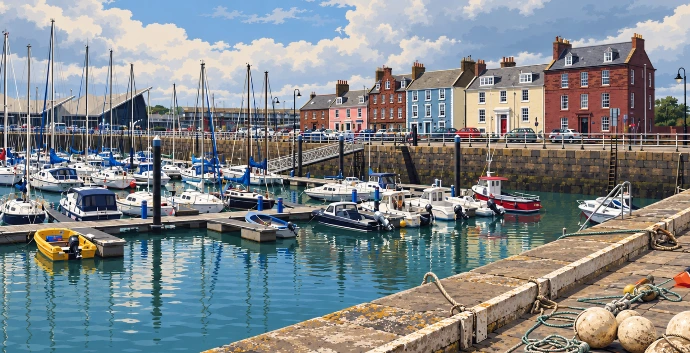
Football is not the only reason the name Arbroath is known far beyond Angus. The town is also synonymous with the Arbroath Smokie, and you really should not leave town without trying one. There is little chance of missing them: Arbroath has around fifteen traditional smokehouses, and the aroma of smoked haddock fills the streets around the harbour. Traditionally produced by smoking haddock over hardwood fires, the smokie originated in the nearby fishing village of Auchmithie before becoming closely associated with Arbroath itself.
The name is protected. Traditionally produced smoked haddock can only carry the Arbroath Smokie designation when it is made within the defined local area using the traditional process. For a travelling football supporter, trying an authentic Arbroath Smokie before or after the match is almost part of the awayday experience. Football, harbour, fishing and food all overlap here.
Smokies are served in many local restaurants, pubs and fish-and-chip shops. The Old Brewhouse is widely regarded as one of the best places to try an authentic Arbroath Smokie. Booking ahead is recommended, as we discovered that it can get quite busy. If you are looking for a more affordable fish-and-chip option, The Marina is also a good choice.
A Town Worth Exploring
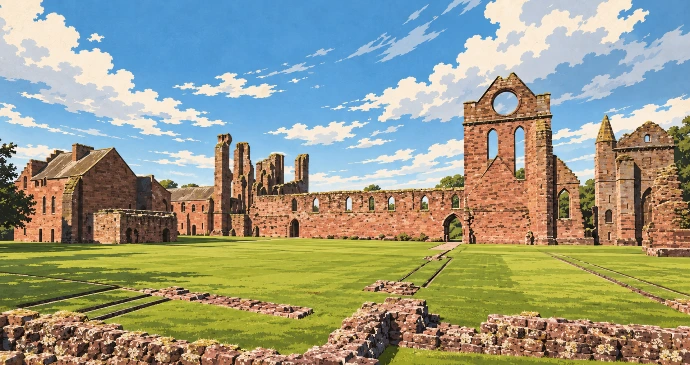
One of the advantages of visiting Arbroath is that the football ground does not exist in isolation. The town itself provides plenty for a visiting supporter or groundhopper to explore.
The remains of Arbroath Abbey are the most obvious historical landmark. The abbey is closely associated with the Declaration of Arbroath, sent to Pope John XXII in 1320 and asserting Scotland’s status as an independent kingdom.
Closer to the coast is the Signal Tower Museum, originally constructed as the shore station serving the Bell Rock Lighthouse.
Then there is the harbour itself.
Walk around this part of town and it quickly becomes clear why the sea plays such an important role in Arbroath’s identity. Only a short distance away stands Gayfield Park.
Why Groundhoppers Should Visit Gayfield Park
There are bigger stadiums in Scotland.
There are more famous clubs.
There are certainly more glamorous destinations.
But that is precisely why Gayfield Park deserves a place on every groundhopper’s list.
You come here for something different.
You come for a traditional Scottish football ground standing beside the North Sea. For terraces filled with supporters in maroon. For old-fashioned floodlights against a grey Scottish sky. For the possibility of horizontal rain and a strong coastal wind that completely changes the match.
You come for the harbour, the smokies and one of Scottish football’s most distinctive awaydays.
You come because football has been played here for generations.
And you come because somewhere in the history of this modest seaside ground sits perhaps the most extraordinary scoreline that competitive football has ever produced.